With a remake now in pre-production it became necessary to review the original for those not yet acquainted with this elegant masterpiece. Originally intended for late night television, this little gem found wider success at midnight showings, double features and various budget VHS and DVD releases.
Studio tampering is a time (dis)honored tradition in the slasher genre. Horror House, A.K.A. The Haunted House of Horror, a forgotten little British chiller, is an early example of a studio destroying a film by radically changing storylines with unnecessary reshoots made without the director’s input.
Over the last couple of years there have been countless Roger Corman productions that have made their way to Blu-ray and now the latest to be upgraded is Francis Ford Coppola’s commercial debut Dementia 13. Having completed work on a picture entitled The Young Racers in Ireland, Corman discovered that he still had some of his budget remaining and so offered Coppola the chance to direct a quick thriller using actors and props from the production, a common method for Corman. Considered by some to be a prototype for the slasher cycle that would follow over a decade later, Dementia 13 slipped into obscurity for many years before being rediscovered on home video.
Looking at the flicks that paved the way for Halloween and the heyday of slasher movies.
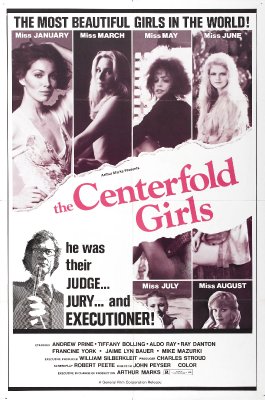
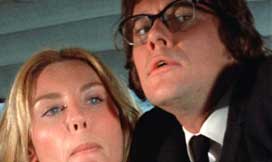
Andrew (Grizzly; Simon, King of the Witches; Terror Circus) Prine stars as Clement Dunne, a repressed psychopath who stalks and kills women who have posed for a nudie magazine called Bachelor. The film is split into three stories. The first follows a nurse (Jaime Lyn Bauer) who travels to the countryside for a job interview. Having graced the pages of Bachelor Magazine in her spare time, she’s also become one of
Clement’s targets, and he’s followed her to the country. This episode is very Russ Meyer-like with our poor nurse being harassed by almost everyone she comes across including a Manson Family-style group of hippie weirdoes and an unsavory motel owner played by Aldo Ray. Bauer goes through so much trauma here that it’s easy to empathize with her, adding to the suspense of the segment, as does Prine’s performance. As
usual, he gives his all, creating a believable creep with homicidal tendencies… and a straight razor.
Next, Clement trails a model (Jennifer Ashley) to an island where she and a group of other models, photographers and industry types are shooting a layout for the magazine. It’s a very giallo-like segment, with bed hopping and backstabbing taking place in equal doses, and Clement slashing his way through the group with luck and aplomb.
In the final segment, Clement stalks a Flight Attendant/Bachelor model played by the great Tiffany (The Candy Snatchers, Bonnie’s Kids, Kingdom of the Spiders) Bolling. His eye always on his victim, Clement intervenes when Bolling is about to be raped by a couple of sailors. Of course, she then finds herself in an even worse predicament. The last scene in this segment, and of the movie itself, is unforgettable. Set among a recently razed forest (in reality, the trees at this location HAD actually just burned down) the charred stumps and bleak landscape look absolutely surreal, and Bolling’s heartfelt primal shrieks are penetrating.
Directed by John Peyser, The Centerfold Girls is a grimy and grim precursor to 80’s slashers like Maniac and Don’t Answer the Phone; it’s also a prime example of 70’s Grindhouse filmmaking. With its dark take on that 70’s standard, the Battle of the Sexes, an argument can easily be made for this as a feminist horror film; the audience empathizes strongly with the women, while almost all the men here are operating on some predatory level, viewing women as things to be used or destroyed. For my money, The Centerfold Girls is essential Proto-Slasher viewing.
On August 10 Code Red DVD releases the 35th Anniversary Edition of Horror High (1974 – do the math on that one). No relation to Return To Horror High (1987), though close together VHS release dates of both films in some countries implied as such, Larry Stouffer’s movie is actually a reliable stock proto-slasher.
Looking at the flicks that paved the way for Halloween and the heyday of slasher movies.
“Blood Feast is like a Walt Whitman poem – it’s no good, but it’s the first of its type”.
– Blood Feast director Hershell Gordon Lewis
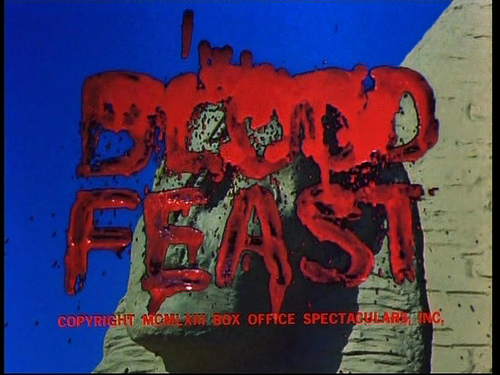
Blood Feast is a joy. The world’s first splatter film delivers the goods and manages to have a sense of humour while seeming campy at the same time.
The story goes that HG Lewis and producer David Freidman were looking for something new in the exploitation market. Their previously successful nudies like The Adventures of Lucky Pierre and Boin-n-g couldn’t compete with the more explicit content being featured in the sex films being produced in the mid-60’s. So where could they turn? Horror was the answer. Why not up the gore quotient and see how it plays?
And so Blood Feast, the story of an insane Egyptian caterer who wants to revive his blood goddess through human sacrifice, was born. Former Playboy model Connie Mason stars as Suzette, a student of Egyptology.
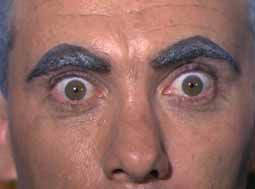
She’s dating Pete (William Kerwin), a detective who’s trying to figure out who’s hacking the female populace of Florida to bits. As Suzette’s birthday approaches, her mother arranges a surprise Egyptian feast through the catering services of the insane and devout Fuad Ramses (Mal Arnold). Ramp up the blood and put on your goggles.
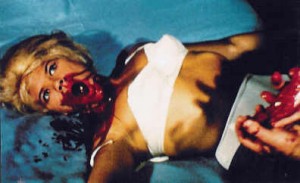
The plot doesn’t matter. What matters is a series of set pieces that are grisly yet unconvincing. The fact that they’re not exactly state of the art effects make them all the more entertaining. Adding to the enjoyment are some truly terrible performances (you can sometimes see actors reading their lines from awkwardly placed notes), and intentionally funny dialogue. The highlights are many… the deep red gore scenes, Mal Arnold’s over-the-top performance, Connie Mason’s complete lack of acting ability, the wonky soundtrack, the wacko dialogue, the faulty logic of the police department, the shoot-it-and-run filmmaking technique, the continuity errors. But these are all pluses in my book. Blood Feast is 67 minutes of entertainment. Watch it with a group of friends and I guarantee you’ll come up with your own favourite moments and quotes you’ll be boring each other with for weeks. I love Tony’s breakdown scene after his girlfriend has had her brain stolen. I love Trudy’s death speech and the music cue that signals her death; it sounds more like a fart than a death rattle. I love that it takes the cops so long to figure out that the mispronounced E-tar is actually the goddess Ishtar, even though one of them has just heard a lecture about her. I love the name of the book Ramses writes, “Ancient Weird Religious Rites”. I love the newspaper headline that screams: “LEGS CUT OFF”. I love… Well, you get the point. There’s plenty to love in Blood Feast country.
I met HG Lewis at a convention about 20 years ago. I asked him where Connie Mason was at that time, and his reply both surprised and delighted me. He said, “She probably crawled back under the rock she came out from under.” Amazing.
Go see Blood Feast if you haven’t already. Love it or hate it, it’s an absolute must for anyone who calls him/herself a horror fan.
Looking at the flicks that paved the way for Halloween and the heyday of slasher movies.
ALICE, SWEET ALICE (1976)
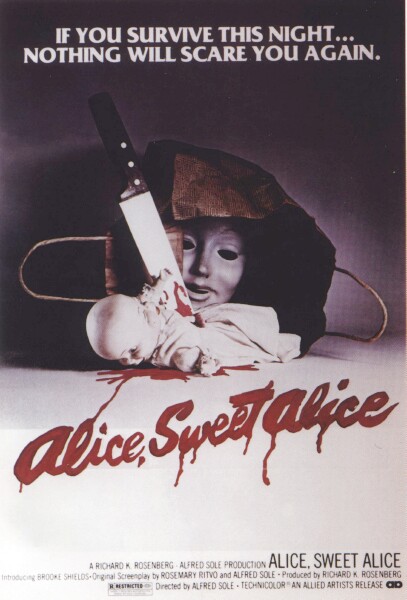
Proto-Slashers frequently contain more plot and depth of character than later straight up classic slashers. A case in point is Alfred Sole’s killer-on-the-loose feature “Alice, Sweet Alice” (a.k.a. “Communion”, a.k.a. “Holy Terror”). Set in 1960’s New Jersey, “Alice” creates a perfect sense of time and place as a young girl prepares for her first communion. Unfortunately (or fortunately, since this is a horror flick), she’s murdered on the big day and her slightly older sister, Alice (Paula Sheppard) becomes the main suspect. A series of murders and knife attacks follows, generating some truly great set pieces.
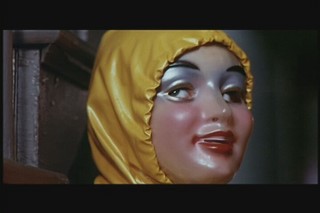
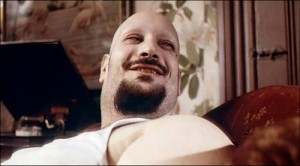
If it’s true that a thriller is only as good as its villain, then “Alice” fits somewhere close to the top of the killer class. This knife-wielder is genuinely creepy and unforgettable, dressed in a yellow raincoat (in an oft noted nod to Nicholas Roeg’s essential “Don’t Look Now”) and wearing a clear mask with painted features. Equally unforgettable is Alphonso DeNoble as Mr. Alphonso, a very large cat-obsessed potential pedophile!
“Alice” is one in a string of deeply Catholic horror movies that emerged in the 70’s (“The Exorcist”, “The Omen”, “The House of Mortal Sin”, etc.). Here, the rituals and icons of the religion are used to eerie and atmospheric effect to explore themes of guilt and sin. Key scenes are set in a church or a manse populated with priests, nuns and the devout. In fact, the atmosphere is primary to the flick’s effectiveness, as the characters deal with their guilt and suspicions about who’s doing the slashing. The cast adds to the overall oppressive atmosphere, giving strong and believable performance with the stellar Sheppard a standout. Also of note is a very young Brooke Shields, here in her much exploited acting debut.
Though “Alice” is sometimes deliberately paced, it’s punctuated by some terrific suspense scenes. It’s a very good movie, almost a great one, and necessary viewing for horror movie fans. And that mask is enough to give anyone nightmares.
Proto-Slashers: Looking at the flicks that paved the way for Halloween and the heyday of slasher movies.
JAWS (1975)
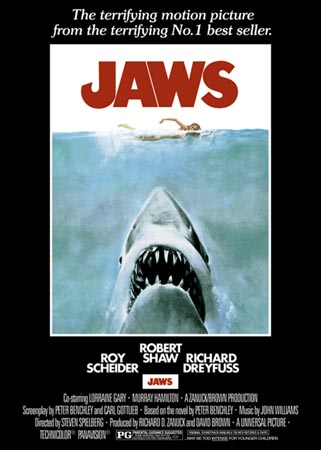
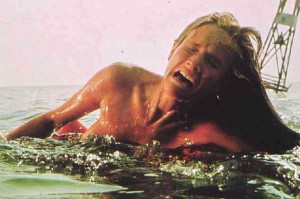
That’s right… Jaws. The story of a killer who terrorizes a small community, leaving many of its inhabitants slashed to bits. Of course, the killer here is a shark and its weapon is its teeth, but underneath its watery surface is a slasher flick of the first order. Especially during its first 3/5’s, Jaws lives up to the traditional slasher formula a full three years before the release of Halloween.
The impact of Jaws is impossible to ignore. After all, this is the film that’s widely considered the first of the summer blockbusters, hitting multiple screens at once and raking in a boat load of cash. Cover stories on all the major (and not so major) publications of the day, special edition shark frenzy magazines, news stories, paperbacks, t-shirts, puzzles, games, LP’s (record albums to the post-80’s crowd), pinball games, etc, etc, etc. Jaws was everywhere. But did it help cement the slasher movie template?
Jaws takes place in a small community. While nerve-jangling theme music fills the soundtrack, the camera assumes the killer’s point of view as the maniac attacks its victims. After a few gory (for its day) deaths occur, those in authority prove to be ineffectual. It’s down to the, not final girl, but the final boy in this case, to stop the killer.
Perhaps it’s in part due to my affinity with slasher movies that I love the first 70 or so minutes of Jaws so much. That’s the part where the shark is hunting prey and the movie is filled with suspense and the kind of thrills I expect from an effective horror flick. I also like the end section of Jaws, but not as much. That part is a more straight forward sea adventure, though still with its fair share of suspense and terror; I love me the Quint-munching and shark cage scenes. But for my money, the real success of Jaws lies in its gill-breathing slasher thrills. It’s also why the first Alien movie will always be my favorite in that series. There’s an unstoppable killer who’s lurking, hunting and dispatching us in spectacular and bloody ways. Who cares if the maniac wears a hockey mask, a glove tricked out with knives, shark skin, or an exoskeleton?
Any other comparisons between Jaws and slasher flicks? Jot ‘em down in the comments section below.
Proto-Slashers: Looking at the flicks that paved the way for Halloween and the heyday of slasher movies.
REPULSION (1965)
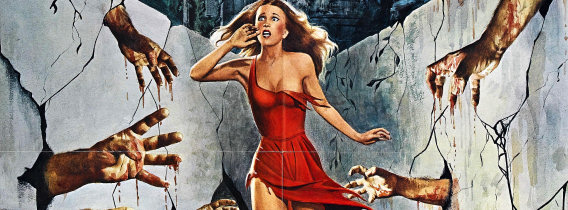
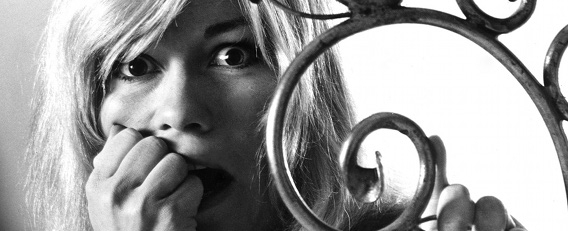
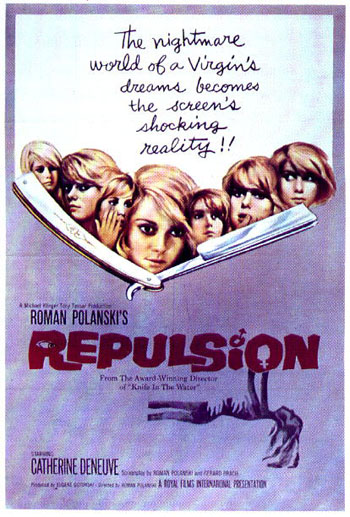
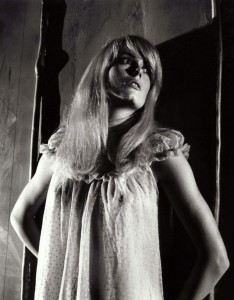
Roman Polanski’s first English-language film, Repulsion is a bonafide, certified Retro Slashers classic, and one of the greatest horror movies ever made. It stars Catherine Deneuve as Carol, a repressed young beautician, sharing an apartment with her sister Hélène (Yvonne Furneaux) in London. While Hélène has a healthy relationship with a boyfriend (Ian Hendry), Carol is terrified by sex. Though Colin (John Fraser), an acquaintance of Carol’s, is persistent in his attempts to get to better know the beautiful and mysterious woman, she would rather spend her time at home, quietly feeding her psychosis. When Hélène and her boyfriend leave for a vacation in Italy, Carol goes fully over the deep end, hanging out with a rotting, skinned rabbit corpse, imaging hands pushing out of walls to grab her, seeking cracks suddenly appear in the ceiling, and thinking she is being attacked by unidentified men. Eventually, those who inhabit the physical rather than the imagined world around Carol learn about alternative uses for straight razors and anything else Carol can get her hands on.
Polanski, one of cinema’s greatest directors, was very early in his career with Repulsion, but his command on the medium is clear. It was the first flick in his unofficial “Apartment Trilogy”, followed by “Rosemary’s Baby” and “The Tenant”, each a variation in a theme, exploring supernatural or psychological threats to apartment dwellers. With Repulsion he created a deliberately-paced, realistic study of a person slipping into full-fledged madness. Punctuated by a handful of well-placed, effective scares, some of which have been copied countless times, the film generates a terrific and creepy atmosphere that engrosses the viewer in Carol’s sick world. Though she has a minimum of dialogue, Deneuve is terrific as Carol, ably conveying her alternating helplessness and her misguided need for protective and violent outbursts. Though not a traditional slasher in the sense of an unstoppable killer hunting for victims, Repulsion finds believable ways to do just the opposite, bringing victims to its killer, who also just happens to be one of the most sympathetic in the genre. Unlike many slasher flicks, Repulsion’s ending is tragic, chilling, and thoughtful rather than jolt-inducing.
Available as a Region 2 DVD from Anchor Bay UK and on Region 1 from Program Power Entertainment, Repulsion will finally get the NTSC release it deserves when the Criterion Collection releases it later this month. It’s a must-own for any horror fan who appreciates horror that creeps rather than winks, squirts, or is CGI-generated.
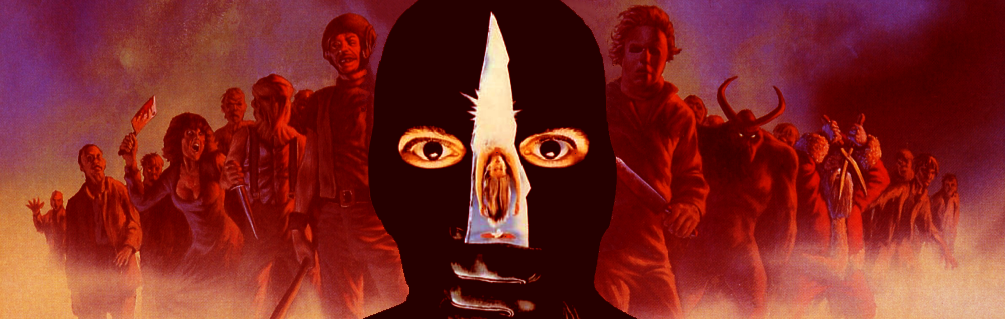
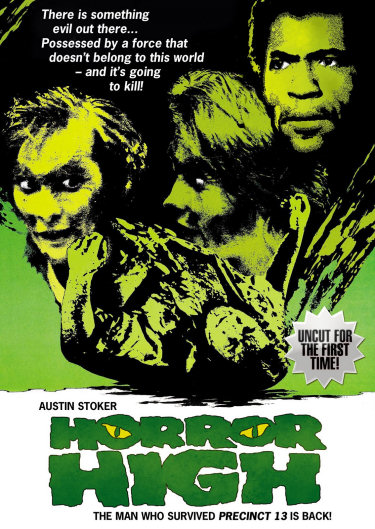 On August 10 Code Red DVD releases the 35th Anniversary Edition of Horror High (1974 – do the math on that one). No relation to Return To Horror High (1987), though close together VHS release dates of both films in some countries implied as such, Larry Stouffer’s movie is actually a reliable stock proto-slasher.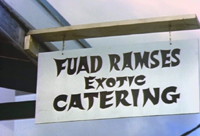

 >
>

 Polanski, one of cinema’s greatest directors, was very early in his career with Repulsion, but his command on the medium is clear. It was the first flick in his unofficial “Apartment Trilogy”, followed by “Rosemary’s Baby” and “The Tenant”, each a variation in a theme, exploring supernatural or psychological threats to apartment dwellers. With Repulsion he created a deliberately-paced, realistic study of a person slipping into full-fledged madness. Punctuated by a handful of well-placed, effective scares, some of which have been copied countless times, the film generates a terrific and creepy atmosphere that engrosses the viewer in Carol’s sick world. Though she has a minimum of dialogue, Deneuve is terrific as Carol, ably conveying her alternating helplessness and her misguided need for protective and violent outbursts. Though not a traditional slasher in the sense of an unstoppable killer hunting for victims, Repulsion finds believable ways to do just the opposite, bringing victims to its killer, who also just happens to be one of the most sympathetic in the genre. Unlike many slasher flicks, Repulsion’s ending is tragic, chilling, and thoughtful rather than jolt-inducing.