Proto-Slashers: Looking at the flicks that paved the way for Halloween and the heyday of slasher movies.
Hands of the Ripper (1971)
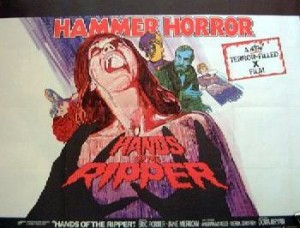
Suppose an infamous serial killer had a baby daughter who witnessed her father murder her mother. Years later, the memory of the event buried, the daughter commits a series of murders herself. That’s the premise of the 1971 Hammer thriller Hands of the Ripper, a terrific and not nearly famous enough late-era flick from the genre-defining British film studio.
As the title reveals, the serial killer/bad role model here is Jack the Ripper. Though his vaguely diseased and scarred face is seen only briefly in the film, appearing in the opening and in several quick flashbacks, his influence is felt throughout. In my books, madmen don’t come much creepier than the Whitechapel Murderer.
The plot really begins to get cooking when Anna (Angharad Rees), the Ripper’s daughter and now a young woman, is taken in by Dr. John Pritchard (Eric Porter). The good doc is obsessed (is there any other kind of doctor in horror flicks other than the obsessed ones?) with unraveling the secrets of the mind, especially those of the schizophrenic. Recognizing the signs of the disorder in Anna, the doctor sets out to cure her, developing a particularly unhealthy variety of codependency. As Anna begins killing, Dr. John (as Anna calls him) hides her crimes, allowing her to continue her murderous behavior.
Though we always know who the killer is, part of the grisly fun of Hands of the Ripper lies in waiting to see who will set Anna off and how. You see, each time the Junior Miss Ripper kills, she falls into a sort of catatonic trance first, facilitated by a kiss and a shiny object glistening in her eyes. It’s surprising how many ways screenwriter L.W. Davidson and storywriter Edward Spenser Shew find to bring these two elements together, happily ushering in yet another attack with yet another sharp object. When the killings do occur, they’re sudden and bloody, often catching the viewer off guard with their urgency.
Davidson and Shew have also given us interesting characters in Anna and Dr. John, as well as in some of the supporting characters. Anna, though a vicious killer, is sympathetic and likeable (when not slashing someone’s neck) and Dr. John is single-minded and purposefully blind to the danger he’s enabling, but with more than enough humanity to be a-okay otherwise. In bringing them together, Davidson and Shew have constructed a much more complex relationship than at first meets the eye.
Davidson/Shew and director Peter Sasdy make good use of the Whispering Gallery at London’s St. Paul’s Cathedral during the film’s climax. It works both as a dramatic setting and, on a more hoighty toighty note, as a metaphor laden with whispers and repeating cycles. Hitchcock would be proud of their use of local landmarks and Freudian hoo-haw. Of course, being a Hammer Horror, Hands of the Ripper is literate and thick with period atmosphere. Though this might all sound a little mellow or highbrow for some gorehounds’ tastes, my advice is to slow down and smell the… er, blood.
Hands of the Ripper is a neat twist on Slasher conventions even before Slasher movies proper existed. Unfortunately, it has yet to be available on Region 1 DVD. Resourceful Ripper freaks, however, can find VHS copies and DVD-R versions available online, and those with Region Free players can pick up the Region 2 disc. With any luck though, MGM’s Midnight Movies series might just see fit to release this flick into the hands of Ripper fans in North America too.
One of the most beautiful things about the horror genre is how utterly subjective it is. One man’s Madman is another man’s Prom Night. OK, I love both of those movies, but you get my point, see? I have spent years analyzing what it is about certain slashers that chill me to the bone. Even now, after so many films, I can still be surprised by what has an effect on me. Case in point, Ghostkeeper.
Ghostkeeper is a truly bare boned affair. Filtered with only a few characters, located mostly in one building and featuring very little in the way of gore, there’s still something so… uh… good, which even now after thinking about it for a couple of days, I just can’t explain. But I won’t let that stop me from trying!
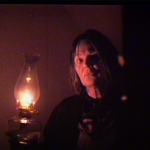
Riva Spier is Jenny, a quiet girl who finds herself in a dead end relationship with Marty (Murray Ord) and together they embark on a vacation that feels anything but fun. They are visiting a desolate, snow-covered mountain with their party-girl buddy Chrissy (Sheri McFadden) and the three take off to parts unknown. After a minor accident, they find themselves seeking shelter at the Deer Lodge, an abandoned hotel. Well, maybe it’s abandoned, since they notice the heat running, even though the guest book informs them there haven’t been any visitors in five long years. Looks like they were right, and finally encounter a creepy old lady referred to in the credits as the Ghostkeeper (Georgie Collins, who truly has a disquieting aura about her). She attempts to boot them out, but because of the ferocity of the storm, she relents and they spend the night. That’s when things get weird. Apparently, this Ghostkeeper is keeping a surprise in her basement. And it’s hungry!
Ghostkeeper doesn’t rely on characterization or story and finds its greatest strengths in the ambiance and the score (by Paul Zaza who also did Prom Night and My Bloody Valentine, among others). There are long stretches of nothingness, yet in that space of air, there’s a feeling of dread so thick you could cut its bloodied heart out with a knife! The desolation in the snowy mountains only heightens the claustrophobia as the film heads towards an ambiguous ending.
Spier is an interesting actress. She’s gorgeous and because the film doesn’t contain a lot of dialog, she expresses herself mostly with cold stares. I can’t tell if Spier wasn’t very good in the part or was fantastic, because her wooden performance actually feels right for some reason. Perhaps it’s because Jenny is terrified of inheriting her mother’s insanity and it’s that fear that keeps the character distant and slightly blank, as if taking in her surroundings before figuring out if it’s safe to react. The rest of the cast is fun, with Collins the stunning winner. Just thinking about her creeps me out.
Loosely based on the Wendigo legend, this Canadian horror film is slasher and monster lite, but has oodles of snow and deep synthesizer sounds to keep you going. Like Madman, or more appropriately, The Prey, Ghostkeeper isn’t hampered by nothingness, it’s enriched by it.
Films become legendary for different reasons. Some are plagued with problems; others manage to transcend the art form and become something else entirely. Then there is the rarest beast indeed, the movie that no one knows anything about. You know it exists, you’ve seen it. You even recognize some of the actors. But somehow little was documented about the actual making of it. A film that fell into that category would certainly be The Prey. A fun, if bewildering, slasher film that despite its low-budget and niche interest has managed to maintain itself in the genre. If you love slashers, you’ve seen The Prey. You may not have loved the film, but I’ll be damned if you weren’t curious about its incarnation.
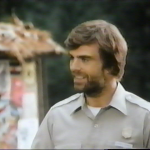
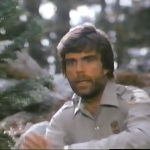
Jackson Bostwick played Ranger Mark O’Brien, the sweet would be hero who tells the infamous ‘wide mouth frog’ joke (he also plays a mean banjo). Jackson was kind enough to sit down and answer a few of the burning questions horror fans have been asking themselves for the last two decades. His answers were quite interesting…
Retro Slashers: How did you get involved with The Prey?
Jackson Bostwick: My acting coach at the time, Lurene Tuttle, recommended me for the part. I went in, read for the director, and got it. They loved a picture I had of me with a two-week beard growth and asked me how long it would take for me to duplicate it. I told them two weeks — duh — and to let me know the start date and it’ll be ready.
RS: I always see varying dates on the release of the movie. When was it actually shot and released?
JB: It was shot in 1978. I’m not sure of the exact release. I know New World picked it up later.
RS: Edwin Brown made a lot of movies for the adult industry. What was he like to work with?
JB: I don’t recall a lot about Ed Brown and his producer wife, Summer, but I do know they were a good team on the set and were very “adult” and professional in their approach to the work at hand.
RS: The Prey was a pretty bare-bones/minimalist movie. Do you remember how long the screenplay was and what it looked like? By that I mean did you know that a good portion of the film would be filler consisting mostly of nature photography?
JB: It seems the script was around 86 pages (or less) in length.
As far as any acting was concerned, I could have phoned in most of my part. But the locations and getting into the outdoors was a hoot.
The Prey was filmed in and around Idlewyld, USC’s summer music camp, in the 9,000 foot mountains above Palm Springs, and Tapia Park over the Santa Monica Mountains opposite Malibu.
I don’t remember seeing a call for a lot of stock footage in the script, but then again, it probably wasn’t listed to a great extent in the Tarzan scripts either — just thrown in whenever nature (or the Ape Man) called for it. (In our case … whenever.)
RS: Debbie Thureson was really good in The Prey and then seemed to disappear. Do you know what became of her or do you have any stories about her?
JB: I didn’t know a lot about Debbie, then or now. I don’t think she became a nun in Austria, or a tour guide in the foothills of Zimbabwe; I guess she just kinda drifted away into oblivion.
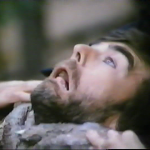
I do recall in the final scene of the movie, however, when I’m supposed to be killed by the mutant love child (who later played Lurch in the “Adams Family” movie); Debbie was having a great deal of difficulty with her emotional CLOSE UP when she sees the forsaken one come up behind me. As I recall, Ed Brown was ready to literally break her neck right after letting the bad boy cinematically break mine. Debbie was rather wanting in any film technique.
RS: Lori Lethin is a very popular actress in horror. What do you remember about her?
JB: Lori was very energetic and bubbly and did a fine job in The Prey. She had a cute figure and was fun to work with and she later worked with my friend, Lurene Tuttle, in the MOW, The Day After (she does quite well with this part, also).
RS: I think the scene fans remember most is the ˜Wide Mouth Frog Joke” scene. Was that written in the script or did you come up with it?
JB: The joke itself wasn’t written in the script. I was verbally told it by Ed before we shot, then I ad-libbed and embellished on it. I did it in my own words for the scene. The fawn did it just for the bananas.
RS: What about the banjo? Did you tell them you could play and they added it?
JB: Correctamundo.
I self-taught myself the Earl Scruggs style, three-finger technique, and then later took instructions from Herb Peterson (who was backing a then up-and-coming singer, Emmy Lou Harris). I told them I could play, and I guess they saw they could save some money on stock footage shots of nature, so they threw it in.
RS: Of course I have to ask about Jackie Coogan. He had an interesting life and was obviously a seasoned performer. What was he like?
JB: Jackie was a very professional actor to work with and as I knew him, a very warm a funny person. He had recently had a stroke before we did the film, but I never really noticed it that much until he signed my script. It took him at least 30 seconds just to write, “The Kid.” Like Red Skelton, Dorothy McQuire, Ann Baxter, Broderick Crawford, and many other greats I have worked with, I’ll never forget him.
RS: What did you think about the final product?
JB: It’s not a Lawrence of Arabia by any stretch of the imagination, but it beats watching a home movie in a closet.
RS: On IMDB, you are listed as the voice of the Jinn in The Outing (aka The Lamp). Is this correct and how did that come about? By the way, I love that movie!
JB: “This is correct, Keeper,” or so the Jinn would say. Not a large part, but a lot of fun.
I was set to do a little film called Break Dancers from Mars with Linda Day George for the Producer of The Lamp (now called, The Outing), Warren Channey. Tobe Hooper of Texas Chainsaw Massacre fame was going to direct Break Dancers. That fell through, but then came The Outing.
RS: The Prey is one of those films that is either loved or hated but it has also endured all these years. Does its popularity in the horror world surprise you?
JB: There aren’t many surprises left for me in the horror world, anymore, but for anything to “still have legs” in that realm is quite refreshing.
RS: You’ve done a lot of work in the genre. Do you yourself like sci-fi and horror? What has been your favorite project so far?
JB: Sci-fi, horror, and fantasy are my favorites with action/adventure close on their heels. These fields are where dreams and imagination can best run their course and allow for that pure escapism that any of the media can provide — especially film.
Escape from DS3 was a fun project. It was one of two films I did for Ann Spielberg (Steven’s sis). The other one was, The Killings at Outpost Zeta. Good luck in finding them anywhere.
RS: When can you tell us about your newest film, Dodge City: A Spaghetto Western, which you also produced? When will we be able to see it?
JB: The new film Dodge City, like the old western town of Dodge City, needs a lot of help. Make no mistake, I didn’t produce it. As to when you will be able to see it … probably, not in this life.
Time for us to delve deeper into the mysterious world of mysterious slasher mysteries, with two classic cases from the Vaults of the Unknown. Last time, readers were kind enough to share their opinions and extra information concerning the conundrums featured, and I encourage you to do so again if you think you know something we don’t. Similarly, reader “the2ndsuitor” posed a riddle of his own involving a cast member from My Bloody Valentine. If anyone feels they can answer it without stumbling into a libel case, please feel free!
Oh, and a warning to the less-seasoned slasher fans: proceed with caution. This volume is pretty heavy on the old spoilers…
CASE #3: The Mystery of the Enigmatic Eye
At least until the release of the 2006 remake, the backstory of “Billy”, the killer in Bob Clark’s 1974 slasher Black Christmas, was one of the most ambiguous ever created. In fact, since the redux is a standalone (and, most would agree, inferior) film, it’s fair to say that, in the sinister world of Clark’s original, Billy was never really identified at all – and he was certainly never killed. All we find out is his name, the name of a previous victim (Agnes, who may have been his little sister) and the fact that Billy is still alive at the end of the story, hiding in the attic to continue his taunting phone calls and, presumably, killing spree.
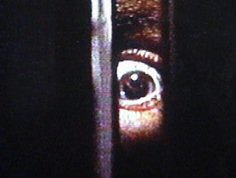
That’s mystery enough, you might think… but no! Before his tragic death in 2007, Bob Clark mentioned that he couldn’t actually remember who “played” Billy in the film’s most memorable and disturbing image: that shot of the killer’s staring eye peering through the door at final girl Jess. Someone out there owns that enigmatic eyeball but, until they come forward, Billy remains one of the most mysterious figures in slasher history.
CASE #4: The April Fool’s Ambiguity
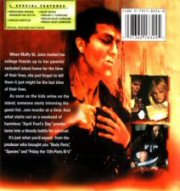
Before you continue with this particular mystery, start by taking out your DVD of April Fool’s Day. Now, you have two options… If it’s the remake, throw it in the nearest bin. If it’s the Paramount release of the original, turn it over and take a look at the pictures on the back. You’ll notice that one prominently featured image shows the character of Skip apparently dead – which is a little odd if you think about it, considering he survives the film.
Well, he survives in the version that Paramount actually released, anyway. The original cut had an entire third act that was filmed but completely deleted before the movie hit theatres, resulting in the current love-it-or-hate-it ending we all know and love (or hate). If you want to read the original ending in its entirety, you can do so right here at Retro Slashers, thanks to a full transcription of the final section of the tie-in novelization. Or, if you’re more of a synopsis-type person, try reading the section in Lost Scenes.
Now the only remaining mystery is: why did that picture turn up on the DVD sleeve in the first place?
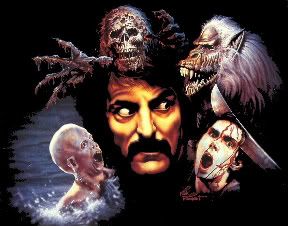
One of the names most associated with the slasher genre is not director or even an actor, but a makeup artist. Tom Savini became synonymous with gory splatter effects in the early 1980’s after his groundbreaking work on the likes of Dawn of the Dead, Friday the 13th and The Texas Chainsaw Massacre 2 turned him into a star in his own right. Savini eventually made his way in front of the camera after semi-retiring from the FX industry and instead concentrating on his acting career. Much of his work became the target of the ‘video nasty’ witch-hunt in the UK and his FX have been under the censor’s knife more than any other. Having raised the bar on what was possible to show on screen, he has also become a horror icon and an inspiration to a generation of special effects artists.
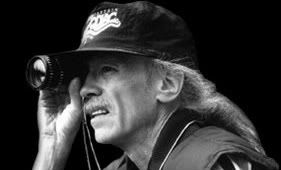
With Halloween 2 set for release later this year, Retro Slashers looks back on the life and career of the man responsible for the original classic,
JOHN CARPENTER.
Back in the late 1970’s Tobe Hooper was set to direct a film titled The Mutilator, a simple tale concerning either the adventures of a zombie slasher or an escaped mongoloid, depending on which Hollywood Urban Legend you read. Hooper only lasted a day behind the camera and was replaced by Bud Cardos. The script by Stanford Whitmore remained the same until producers saw the box office returns for Star Wars and decided a Sci-Fi film would make more money than a slasher. So The Mutilator became The Dark and the zombie slasher/escaped mongoloid killer became an alien with the ability to shoot laser beams from his eyes.
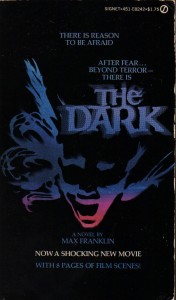
Fortunately for slasher fans, the 1978 novelization of The Dark was written before the drastic changes to the film occurred. The main cast of characters are the same as the film but the killer is Harmon Quade, an ex-sailor who developed a taste for human flesh and was lynched for his crimes in 1878. One hundred years later, Quade comes back to town with his trusty scimitar. He strikes every night, decapitating his victims before munching on their still warm bodies.
Journeyman writer Richard Deming, using his Max Franklin pseudonym for The Dark, excels in developing the approaching darkness into a malignant threat. The actions and paranoia of minor characters faced with the looming nightfall creates a level of tension and atmosphere not found in the film. The main characters in the novel, however, are rather cartoonish and come across as bad 70’s cliches. You’ve got Roy Warner, the tough loner ready to go Death Wish all over the monster who killed his daughter. You’ve got the tough feminist reporter ready to prove she doesn’t need no stinking man to make it in the world. You’ve got the tough Dirty Harry style cop who likes to shoot suspects first and ask questions later. You’ve got the tough old psychic who develops a link with the killer. The only cliches missing are the tough biker and tough kung-fu master.
Another problem plaguing the novel is Deming doesn’t answer all of the questions the reader has by the end of the novel. We never really learn who Quade was in life, how he came back from the dead, how he found a scimitar, or where he was hiding between 1878 and 1978. A blind man appears at every killing but his true identity is never revealed. It’s obvious he’s involved in the killings somehow but his origin is left up to the imagination of the reader.
The novelization of The Dark, only 187 pages, offers slasher fans a glimpse at what might have been a decent slasher film if Hooper hadn’t self destructed and the producers hadn’t radically changed the story. It isn’t difficult to imagine Harmon Quade as an early version of zombie Jason Vorhees especially when you read Quade’s physical description. 8 pages of photos are included in the novel. Some of the photos are nothing more than publicity shots but a few show scenes that aren’t included in the book.
I’ve been wanting to do a little tribute to The Prey, one of the more underrated slashers, but as you may have noticed (or not!), I’m only on RS sporadically (something I truly regret), which means Prey week is looking like it might not happen. So instead, I thought I’d do my posts in piecemeal.
Today, I will present an interesting influence The Prey had on Wrong Turn:
The Prey:
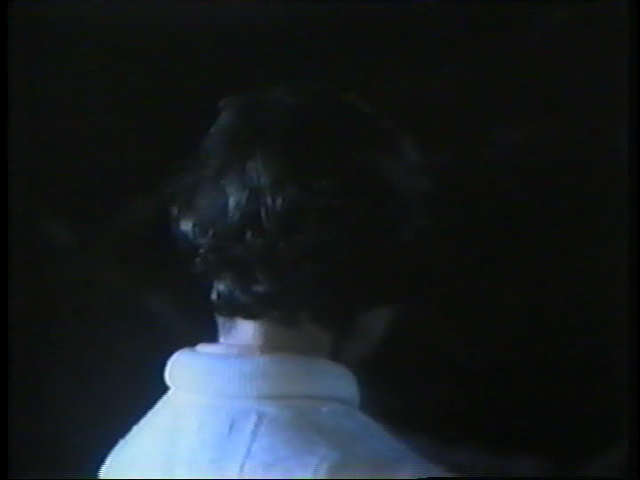
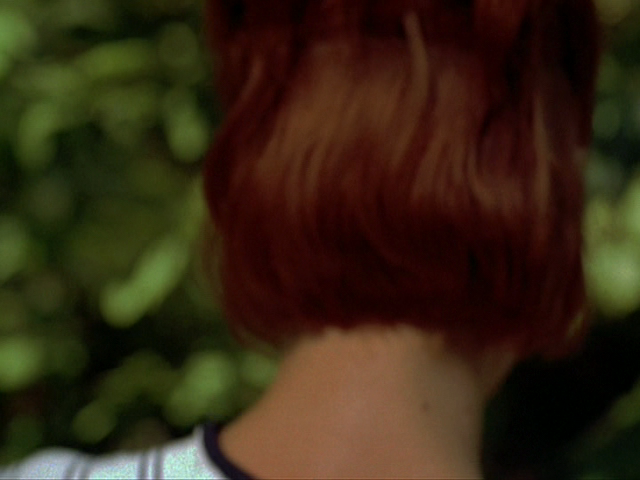
I have always loved this odd camera shot featuring the back of this victim-to-be’s head. Moments away from terror and death, there’s something so strangely weird about this shot that compliments the surreal setting.
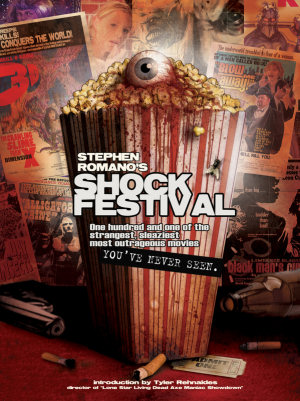
Rue Morgue’s Best Fiction Book of 2008, SHOCK FESTIVAL, is getting a DVD adaptation (of sorts). Fangoria recently posted an insightful Interview With Author Stephen Romano which outlines plans for the disc.