Lost Slashers: Pitchfork Massacre (1984)
On February 24, 1984, Pitchfork Massacre hit the big screen at the Apollo Cinema in my hometown in South Carolina. The film played for one week then vanished. It has never been mentioned since… until now.
On February 24, 1984, Pitchfork Massacre hit the big screen at the Apollo Cinema in my hometown in South Carolina. The film played for one week then vanished. It has never been mentioned since… until now.
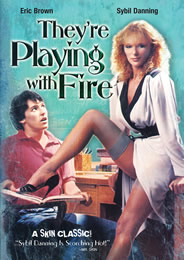 In 1983, Hikmet Avedis & wife Marlene Schmidt wrote & produced Mortuary, which Hikmet directed. A year later they were back in the same capacity with They’re Playing With Fire. Taking the plot of their 1974 movie The Teacher, and Eric Brown – the star of the popular Private Lessons (1981), it starts off simple – a teenage boy reciprocates the sexual advances of his sexy mature teacher. But from there on it gets much more complex as the film progresses – the tryst is part of a plan involving the teacher and her husband (who may or may not be “in” on everything) to get their hands on a family inheritance, which is soon helped along when a masked killer murders the old bats keeping the fortune at bay. Coincidentally after the teen had just been lurking in the cellar on a scare-em-shitless mission for his lover. Then his girlfriend gets her hands on photos of the taudry tryst and threatens to use them. Got that?
That’s just the first half hour of the spider-web like plot. I almost needed to make a chart to keep track of all the characters and relationships. But it’s all happening for a reason. Each character is a player or pawn in the game this film lays out. The boy. The girlfriend. The teacher. The husband. The gardener. The slasher. Each has a part to play and ulterior motives that are slowly unveiled.
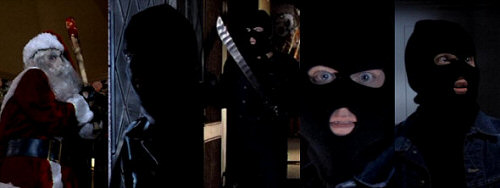
The slasher appears sparsely in the first half of the film, but drives the film forward when he does appear. Even in the scenes he’s not in, listen closely, as snippets of his backstory and identity are slowly unspooled in increments building towards a final twist that makes a second viewing a treat. In the second half of the film, he seeps into more and more of the plot until the final half hour is firmly entrenched in slasher-land. This slasher has some personality – a shattered state of mind subtlety visualized by his high contrast costume – black balaclava, blue denim jacket, white running shoes. He mutters twisted childhood speak hinting at long-ago transgressions and watches with stark wide open eyes reminiscent of Andrew Robinson’s Scorpio character in Dirty Harry. And, allow me to digress, but I’ve always hated in late 90s slashers how the culprits would be strictly blade-men but then switch to a gun in the climax (usually as a tool to keep the final girl still while the killer explains his hate-my-daddy motives), but on the other hand there were a few 80s slashers whom could have really pulled themselves out of a fatal bind by using a gun. They’re Playing With Fire‘s killer effortlessly switches between implements of slaughter according to whatever fits the situation. From a high powered rifle to a blunt baseball bat to a sharp machete!
They’re Playing With Fire has alot in common with Mortuary besides the same creative team and close proximity to its year of production. Both share cast, too: Greg Kaye, Violet Manes, Bill Conklin, Curt Ayers, Marlene Schmidt herself, and Alvy Moore in a cameo role as an employer of the young male lead. Both have a suitably evocative score by John Cacavas. Both are set in Californian shoreside locations and their affluent expansive mansions. Both milk dark shadowy rooms for maximum suspense. Dead bodies displayed echo the similar of the party table scene in Mortuary. Both have ancillary teen characters that pop up sporadically but aren’t really part of plot. They’re Playing With Fire also uses some of its similarities to tweak what didn’t work in the earlier film – i.e., Bill Paxton in Mortuary was immediately guessable as the killer (and strangely, even had a scene early in the film in costume but without mask that made one wonder if they were even trying to hide his identity), while the killer here remains an enigma throughout and keeps the ultimate secret behind his mask locked up safely until the final scenes.
Some random notes – Eric Brown plays the teenager in-over-his-head a bit too innocently at times. The first time Sybil Danning beds down with him, she’s grinding him like a juicer and oohing and ahhing along the way and he’s making idle conversation like he’s numb from the waist down. He’s supposed to be someone on the verge of manhood but frequently comes off as much younger. In fairness to Brown, this “innocent little boy” element is a prevalent in the writing of this type of genre (see the aforementioned Private Lessons – also Brown) And Sybil, oh Sybil. Truly the hottest 80’s woman on film with her ample, bronzed body and… ah, whoops. Back on point. Andrew Prine turns in a reliable performance as the husband, Michael, in a similar suspicious role as Christopher George played in Mortuary. Dominick Brascia from Friday The 13th Part V: A New Beginning contributes another sterling performance as a hungry fatso, and in one frustrating scene manages to unknowingly escape death after pissing in a garden while the killer hides behind a nearby statue. So close, yet so far!
It’s a film those few who have reviewed it have enjoyed because they insist the film doesn’t “make up its mind” if it wants to be a sex film or a slasher. Which to me is the silliest statement ever – as if a film should be whipped for not fitting a specific category – and you know if it did fit firmly in a mold, it’d be slammed for being just like all the others. It is indeed an odd duck to classify, but that’s what makes the flick so watchable. It’s always hard to guess what’ll happen next because it could switch to either genre – it’s part sex film, part thriller, part slasher. The distributors had to make a choice of what angle to play up and chose “sex romp”. But it would be a doomed scenario either way – had they marketed it as a slasher, fans of the time would be disappointed it doesn’t follow the prescribed format of teen leads and a kill every ten minutes. As a result of the title and marketing, this film has flown under the radar of even some of the most seasoned retro slasher fans – until now?
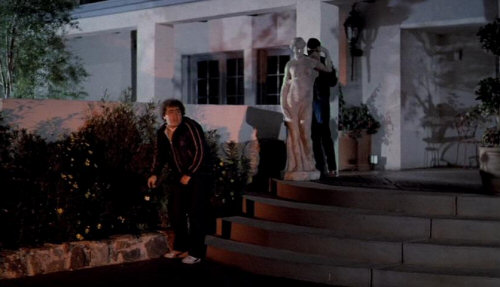
This review was originally written in 2007
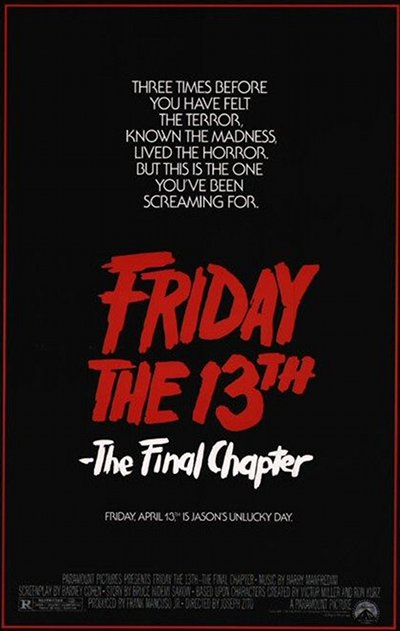
After three successful, if somewhat critically mauled, feature films, Paramount finally decided to lay their lucrative Friday the 13th franchise to rest with what promised to be The Final Chapter.
The slasher movie had become such a dominant force at the box office during the early eighties that, despite the critics refusing to acknowledge its importance, they soon began to influence mainstream cinema.
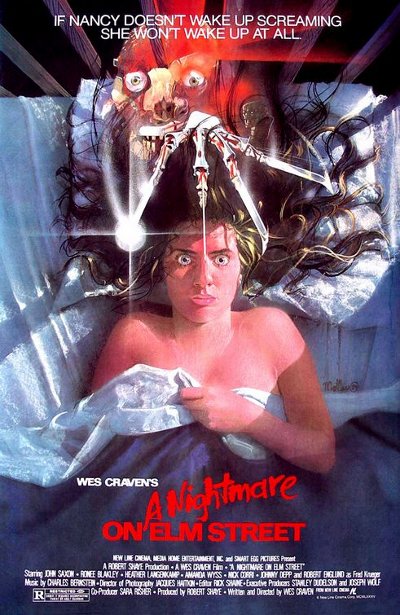
As the slasher boom came to an end, with most major studios bowing out of the genre and leaving just the independent filmmakers to milk the concept dry, a struggling director by the name of Wes Craven had penned a script full of original ideas and inventive deaths,
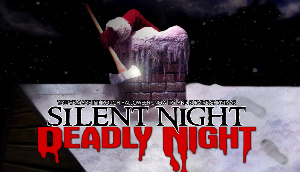
Of all the slasher movies to meet controversy in the 1980’s, perhaps the most loathed of these was the festive tale Silent Night, Deadly Night, which was picketed by angry parents and pulled by the studio. Still unreleased in several countries, this tale of a homicidal Santa Claus was not the first festive slasher
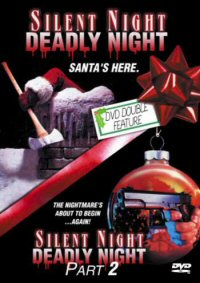 Silent Night, Deadly Night was a mean spirited little entry in the slasher canon that carried more notoriety on its shoulders than it was worth. Not to say it’s a bad slasher – it does manage some moments that get under your skin – like the suddenly non-comatose grandfather and the nighttime family assault that sets the trauma for the murders to come. Silent Night, Deadly Night Part 2 is just camp all the way. I can’t only justify it any other way. Except to say, its liberal use of footage from the first film makes it a good two-in-one if you want to watch part one trimmed of its fat.
Audio/Visual:
It’s AB, which ensures the movies are both widescreen and crystal clear in both picture and sound, but there is an aspect on the first entry of note – when you see previously cut gore footage, the quality changes to muddy. If that was the best quality source availible, I’m cool with that – and AB had the pre-thought to mention this fact straight up at the start of the DVD.
Supplements:
Unfortunately the extras are a little topsy turvy – SNDN2 has more while SNDN1 has less then it should. For example, we get the screenplay for part two but not for part one – when the website listed in the included booklet (by Adam Rockoff) had a copy available for use.
Part one features an audio interview with director Charles E. Sellier Jr. conducted by Adam Rockoff (my guess, probably culled from the raw tapes of his Going To Pieces research). Rockoff asks all the right questions and Sellier still seems ashamed of the film after all these years – but hey, he consented to talk about it and that should be applauded.
The features – Santa’s Stocking of Outrage and the Poster/Still Gallery adequately cover the journey of an exploitation film both visually and via text. Mickey Rooney even slams the film viciously – only to later star as the lead in Silent Night, Deadly Night 5: The Toymaker!
Part 2 features an audio commentary by writer/director Lee Harry, writer Joseph H. Earle and actor James Newman. While the director and the writer have interesting things to say and balance their thoughts between knowingness (and agreement) of the film’s reputation and quiet appreciation of the small victories they did pull off, actor Newman, who played the psychiatrist, takes the stand-up approach, cracking wise thus audibly cutting down the boys’ attempts to relate straight info.
A fairly pedestrian theatrical trailer for part two is featured, as is the original screenplay but the low key gravy is the Still Gallery – it contains original storyboards which show that indeed, work did go into creating SNDN2.
Graphics:
Both menus and packaging are in a festive holiday style, thanks to AB’s great design team. I guess the only qualm I would have is that there is no usual insert featuring original art. I have double disc cover art getting mussed up by having to squeeze in two cover art representations. But hey, that’s just me nitpicking – this is AB’s best looking package so far – no small feat!
This release is now Out Of Print.
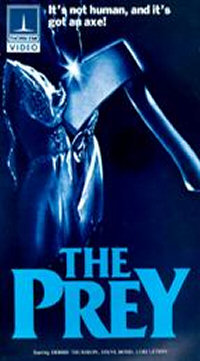
It’s almost impossible to look past such a salacious tagline as “It’s not human and it’s got an axe”, therefore, I didn’t. While I was slightly disappointed that it was human, he still carried that axe with enough murderous glee to make up for that shortcoming.
The Prey is an oddity for sure. Approximately half of the film’s running time is filled with nature footage. Pretty great if you’re Mutal of Omaha’s Wild Kingdom, but as an edge of your seat slasher, shots of centipedes walking doesn’t always generate the scare factor. Yet, when the viewer gets to the film’s disturbing finale, you’d be hard pressed to say it wasn’t at least jolting.
The story – six young campers hike to a remote part of the wilderness unaware that an angry and charred gypsy (!) is bent on avenging the death of his clan due to a man-made forest fire. He was apparently left scarred… and pretty pissed off. Granted, throwing in a crispy gypsy is certainly inventive, but The Prey is a strictly by the numbers story without much flare given to the characters or their dialogue. In fact, some of the scenes were looped together, as if this were a porn (the filmmaker made adult movies at the time, and it’s rumored that there is an adult version of this somewhere in the ether) but it’s looped together backwards, which means you catch the end of the conversation then it wraps backwards and starts a bit earlier, winds back to the end and then loops towards the beginning again! Whew! There’s art in there somewhere, there just has to be!
What The Prey lacks in story it makes up for with atmosphere. Somehow that extraneous footage of animals frolicking does work in creating a bit of suspense, maybe because it’s just so weird that it constantly pulls the film from a semi-realistic to a still surrealistic slasher. Also, the location is just magnificent. Beautiful and lush greenery fill every frame until the last third when our campers hit a desolate and barren rock. It’s a stark contrast to the beauty and it adds a bit of oomph to the climax.
The actors are pretty game as well. Jackson Bostwick takes the lead as Ranger Mark O’Brien. His wide-mouth-frog story adds a bit of flavor to a flavorless character. I was quite smitten with Bostwick’s portrayal here and thought he’d make an interesting leading man in just about anything. Other familiar faces include an older Jackie Coogan, Carel Struycken, former Playgirl Playmate Steve Bond and the loveable 80s Scream Queen Lori Lethen. So, if I can quote the opening theme song to Facts of Life (yeah, strange segue but there you go), “you take the good, you take the bad, you take them both, and there you have -” If Mrs. Garrett was ever onto something, it’s that lyric. The Prey mixes the good and the bad and then there you have – a pretty damn fine slasher.
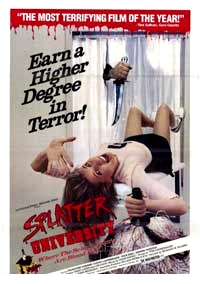
A psycho escapes from a mental institution. Three years later, the female students and teachers of St. Trinians College fall victim to the knife wielding slasher. The new teacher on campus (Francine Forbes) thinks she knows the killer’s identity. After the deaths of her friends, the young teacher confronts the killer in the hallways of the college.
Splatter University is an entertaining slasher film for all of the wrong reasons. Director Robert Haines is so inept that he allows numerous mistakes and gaffs into the film. A few mistakes include bad post production dubbing, dead bodies that move, and a doctor with bloodstains on his coat before he’s attacked by the killer. The mistakes are often more entertaining than the actual film.
Writers Michael Cunningham, Robert Haines, and John Michaels produced dialog filled with crude humor and bad one liners. Unfortunately, they forgot to add depth to their characters and suspense. Gore consists of knife penetrations and plenty of squirting blood. Even though the camera zooms in on girls wearing tight jeans and shirts, there is no nudity except for a cover of Look magazine. When you see the female students, you’ll be glad they kept their clothes on. The soundtrack is one annoying song that plays throughout the movie.
Francine Forbes is the only real actor in the cast. She brings a charming innocence to this film. The rest of the cast must be friends or relatives of the filmmakers. They obviously weren’t hired on talent or good looks. The killer’s identity is a bit of a surprise, but the actor looks too silly to be menacing.
Splatter University is so badly made that it’s actually entertaining. If you’re looking for frights and suspense, then look somewhere else. Splatter U. works best as a party film, something to watch with a room full of friends. It’s good, sleazy fun.
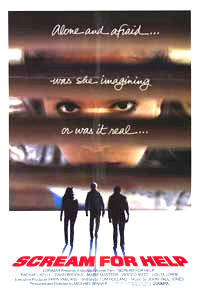
Christie (Rachael Kelly) is sure her new step-father, Paul Fox (David Brooks), is trying to kill her mother but none of her friends or family take her warnings seriously. The suspicious teen stalks her step-father and his lover, Brenda (Lolita Lorre), in an attempt to gather evidence proving Fox’s evil intentions. Eventually, Christie convinces her mother that Paul is a cad and has him tossed out of the mansion. The happy ending is ruined later that evening when Paul, Brenda, and the psychotic Lacy (Rocco Sisto) invade the house to murder mother and daughter so Paul can inherit the family fortune. Three desperate killers face off against one angry girl armed with quick wits and a butcher knife in the bloody, suspenseful final reel.
The most impressive element concerning Scream for Help is the major talent working behind the camera. Irwin (Halloween, Hell Night, Fade to Black) Yablans acted as executive producer and Michael (Death Wish) Winner directed. Tom Holland, already a slasher screenplay veteran with Psycho II, provided the script before creating the Fright Night series and Child’s Play franchises. Former Led Zeppelin bassist John Paul Jones wrote the synth score that pounces on the viewer whenever a bit of nastiness is about to occur.
Holland’s script, besides featuring several nail-biting sequences, is very subversive. Having the sweet, innocent heroine perform the stalking and slashing under cuts the criticism from mainstream critics that slasher films are nothing more than scenes of evil men harming helpless women. Christie spills more blood and racks up a higher body count than the three villains. Holland also taps into and exploits the universal fear of a wicked step-parent. Adults are blind to Paul Fox’s evil but a step-child can easily see past his handsome facade.
The most recognizable face in the film is Corey Parker, best known for taking a crap in the woods while his buddy is eating a road flare in Friday the 13th V. Parker plays a horny boyfriend who’s always too busy getting busy to notice his lady is in danger. At times Rocco Sisto comes across as a poor man’s David Hess, yet he gives the best performance in the film. Lolita Lorre is well cast as the seductive Brenda. Lorre alternates between electric sexuality and cold, smoldering cruelty.
Scream for Help is a suspenseful little slasher with a good pedigree. The forces behind this film made something different from the average slasher flooding theaters back in 1984. Sometimes Scream for Help plays like an after school special on crack with serious teenage topics being discussed shortly before the shocking sex and mayhem kicks in. Those watching the Lorimar VHS edition of Scream for Help should check out the three trailers following the closing credits. American Anthem looks pretty generic but the extended Max Headroom preview and the theatrical trailer for Maximum Overdrive featuring Stephen King provide a real nostalgic blast from the past.