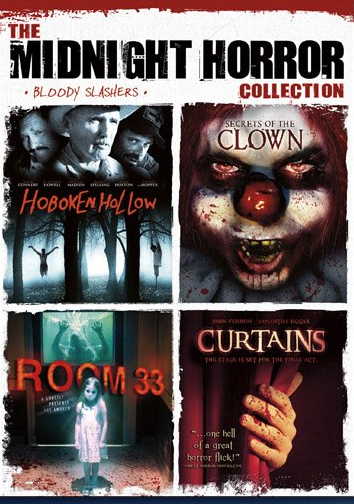
The 1983 Slasher Classic “Curtains” is out on DVD, legally released and without any fanfare. Starring John Vernon and Samantha Eggar, and co-directed by Richard Ciupka and Peter Simpson, “Curtains” is the flick with that indelible scene featuring a skater chased by a hag mask-wearing killer brandishing a scythe. It’s a title that Slasher fans have been screaming for for years. So why no PR?
Released by Platinum Disc in October of 2010 as part of a four-movie set called the Midnight Horror Collection, according to Rue Morgue Magazine, the version of the movie presented here is less than stellar (i.e. full-frame and sourced from VHS). Still, for those who haven’t seen “Curtains”, or for those longing to re-visit it again, this is the only legit way to go at the present (“Curtains” is a mainstay in the DVD-R grey market). I suspect the other movies in the set – Hoboken Hollow, Secrets of the Clown, and Room 33 – won’t do much to lure customers. However, “Curtains” stands as a fine example of the Golden Era Slasher, and until a Special Edition comes along, this may be worth picking up for that hag mask/scythe scene alone.
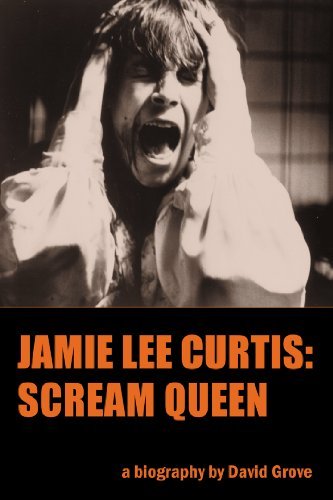
Reading Jamie Curtis: Scream Queen (published by BearManor Media) is like having a conversation with a friend who is fanatical about the actress. Thing is, it’s not like having one of those boring conversations where you wish your friend would shut up; it’s the type of conversation where you’re likely to ask (several times), “And then what happened…?”
Author David Grove has done an exhaustive amount of research, conducting countless interviews with the casts, crews and the filmmakers of Curtis’ early films, as well as ex-boyfriends, members of Curtis’ family, etc. As the book’s title suggests, Grove dedicates the majority of its 492 pages to Curtis’ Scream Queen career, specifically from Halloween through to Halloween II. Between the two Michael Myers flicks, The Fog, Prom Night, Terror Train, and Roadgames all have double chapters dedicated to their making and release. It’s probably the most thorough examination these films are likely to see.
Grove begins the book with background on Curtis and her upbringing as the daughter (along with sister Kelly, star of Michele Soavi’s The Sect) of Hollywood Golden Couple, Janet Leigh and Tony Curtis, and ends with her success in escaping Final Girl typecasting. Curtis’ struggles with her lineage, her unconventional good looks, relationships and career are all included here. As Grove states in the book, one of his goals in writing it was to document “the horror boom between 1978 and 1981.” Add to this the Curtis bio and retrospectives of six films, and you’ll realize that Grove has set some pretty large objectives for himself. Fortunately, Grove is up to the task, and provides an in depth and entertaining examination of each subject.
Some of the book’s most intriguing information, from my perspective, comes in shedding light on the reasons behind some of Curtis’ career choices, and in the details of the behind the scenes info. If you’ve ever wondered why an actress who wanted to escape her Scream Queen persona would do six horror flicks in a row, or why Curtis’ hair looked so bad in Halloween II, the answers are all here, folks!
The presence of John Carpenter and Debra Hill is felt throughout the book, and it’s clear that Curtis sees them as the people responsible for starting her career. Both Carpenter and Hill are quoted frequently here, giving insight on Curtis and the films that the three made together. Hill’s death in 2005 gives the book the air of being the final word on the subject.
Grove, who has written for Fangoria, Film Threat, and Rue Morgue among other publications, is currently in the planning stages of a second book about the Friday the 13th films for FAB Press. In the meantime, for anyone with an interest in one of our genre’s most likeable, talented, and in some senses trailblazing Patron Saints, Jamie Lee Curtis: Scream Queen is a must read.
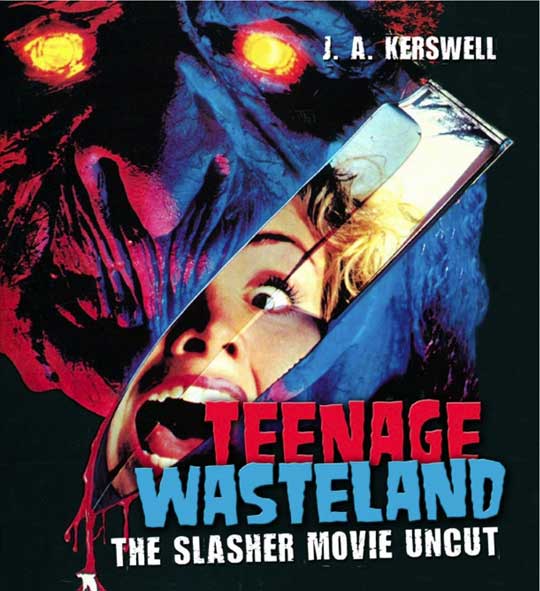
The history of our beloved genre has been amassed into one essential tome by J.A. Kerswell, founder of the terrific Hysteria Lives! website. Clocking in at 208 pages and published by New Holland Publishers, Teenage Wasteland is a fast, entertaining and informative read. Kerswell traces the evolution of the slasher flick beginning with the Grand Guigol in France (crowd-pleasing theatre that featured bloody effects and sadistic plotlines), stops by Hitchcock’s groundbreaking Psycho before moving on to the German (Krimi) and Italian (Giallo) thrillers of the 60’s and 70’s, detours into grindhouse and drive-in flicks, and then gets to the meat of the matter with the true birth of the slasher film – John Carpenter’s genre-defining Halloween.
Kerswell explores the slasher move explosion that followed in Michael Myers’ wake during its “Golden Age” from 1978 through 1984, but he doesn’t stop there. Looking at slasher flicks from around the world, direct-to-video DIY jobs, contemporary stabs at the genre, as well as reboots, remakes and reimaginings, he’s also thought to include a glossary of slasher terms, movie body counts, box office receipts, reviews of key slasher movies, and a list of recommended reading and websites (including www.RetroSlashers.net – yay for us!).
Teenage Wasteland is written with a fan’s love of the genre and an obsessive’s knowledge. Kerswell certainly knows his stuff, and he happily doesn’t fall into the trap of blindly praising a movie just because it features a knife-wielding killer and a Final Girl. As a slasher fan, this book is a pleasure to read, and the colourful and perfectly appropriate eye-catching design is an added bonus that encourages the reader to linger over almost every single page.
Teenage Wasteland is a welcome addition to the list of essential books about horror movies that includes Michael Weldon’s Psychotronic Encyclopedia of Film, John McCarty’s Official Splatter Movie Guide and Stephen Thrower’s Nightmare U.S.A., and it’s the best resource book slasher fans can get their bloody hands on. If you’re lurking on this website, you’re obviously a slasher fan… Why don’t you have this book? Just don’t be surprised if you find yourself trying to source movies like Room 13 and Fright after you’ve been though its pages.
Looking at the flicks that paved the way for Halloween and the heyday of slasher movies.
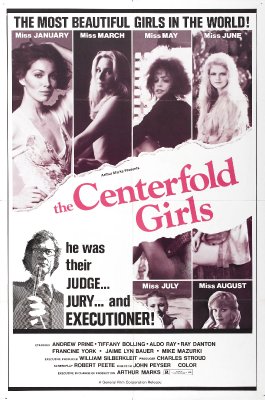
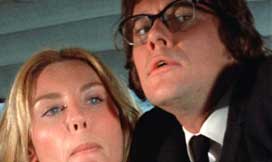
Andrew (Grizzly; Simon, King of the Witches; Terror Circus) Prine stars as Clement Dunne, a repressed psychopath who stalks and kills women who have posed for a nudie magazine called Bachelor. The film is split into three stories. The first follows a nurse (Jaime Lyn Bauer) who travels to the countryside for a job interview. Having graced the pages of Bachelor Magazine in her spare time, she’s also become one of
Clement’s targets, and he’s followed her to the country. This episode is very Russ Meyer-like with our poor nurse being harassed by almost everyone she comes across including a Manson Family-style group of hippie weirdoes and an unsavory motel owner played by Aldo Ray. Bauer goes through so much trauma here that it’s easy to empathize with her, adding to the suspense of the segment, as does Prine’s performance. As
usual, he gives his all, creating a believable creep with homicidal tendencies… and a straight razor.
Next, Clement trails a model (Jennifer Ashley) to an island where she and a group of other models, photographers and industry types are shooting a layout for the magazine. It’s a very giallo-like segment, with bed hopping and backstabbing taking place in equal doses, and Clement slashing his way through the group with luck and aplomb.
In the final segment, Clement stalks a Flight Attendant/Bachelor model played by the great Tiffany (The Candy Snatchers, Bonnie’s Kids, Kingdom of the Spiders) Bolling. His eye always on his victim, Clement intervenes when Bolling is about to be raped by a couple of sailors. Of course, she then finds herself in an even worse predicament. The last scene in this segment, and of the movie itself, is unforgettable. Set among a recently razed forest (in reality, the trees at this location HAD actually just burned down) the charred stumps and bleak landscape look absolutely surreal, and Bolling’s heartfelt primal shrieks are penetrating.
Directed by John Peyser, The Centerfold Girls is a grimy and grim precursor to 80’s slashers like Maniac and Don’t Answer the Phone; it’s also a prime example of 70’s Grindhouse filmmaking. With its dark take on that 70’s standard, the Battle of the Sexes, an argument can easily be made for this as a feminist horror film; the audience empathizes strongly with the women, while almost all the men here are operating on some predatory level, viewing women as things to be used or destroyed. For my money, The Centerfold Girls is essential Proto-Slasher viewing.
Posters help sell a movie. They catch the public’s eye and, if you’re the right target for what they’re selling, they should encourage you to buy that ticket. Though the art is somewhat dead today (too many Photoshopped pictures of teen stars, not enough design), there are still plenty of examples from the golden age of slasher flicks (admittedly filtered through nostalgia) that successfully hint at the suspense, shocks and depravity the flicks they’re huckstering promise to contain. Though not all of the flicks represented are worth watching, there’s something about their posters that I respond to. Take a look, and add a comment about your favourites (or the ones you’d knock off the list).
Looking at the flicks that paved the way for Halloween and the heyday of slasher movies.
“Blood Feast is like a Walt Whitman poem – it’s no good, but it’s the first of its type”.
– Blood Feast director Hershell Gordon Lewis
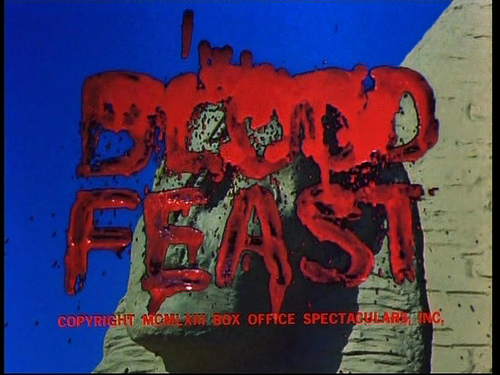
Blood Feast is a joy. The world’s first splatter film delivers the goods and manages to have a sense of humour while seeming campy at the same time.
The story goes that HG Lewis and producer David Freidman were looking for something new in the exploitation market. Their previously successful nudies like The Adventures of Lucky Pierre and Boin-n-g couldn’t compete with the more explicit content being featured in the sex films being produced in the mid-60’s. So where could they turn? Horror was the answer. Why not up the gore quotient and see how it plays?
And so Blood Feast, the story of an insane Egyptian caterer who wants to revive his blood goddess through human sacrifice, was born. Former Playboy model Connie Mason stars as Suzette, a student of Egyptology.
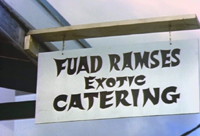
She’s dating Pete (William Kerwin), a detective who’s trying to figure out who’s hacking the female populace of Florida to bits. As Suzette’s birthday approaches, her mother arranges a surprise Egyptian feast through the catering services of the insane and devout Fuad Ramses (Mal Arnold). Ramp up the blood and put on your goggles.
The plot doesn’t matter. What matters is a series of set pieces that are grisly yet unconvincing. The fact that they’re not exactly state of the art effects make them all the more entertaining. Adding to the enjoyment are some truly terrible performances (you can sometimes see actors reading their lines from awkwardly placed notes), and intentionally funny dialogue. The highlights are many… the deep red gore scenes, Mal Arnold’s over-the-top performance, Connie Mason’s complete lack of acting ability, the wonky soundtrack, the wacko dialogue, the faulty logic of the police department, the shoot-it-and-run filmmaking technique, the continuity errors. But these are all pluses in my book. Blood Feast is 67 minutes of entertainment. Watch it with a group of friends and I guarantee you’ll come up with your own favourite moments and quotes you’ll be boring each other with for weeks. I love Tony’s breakdown scene after his girlfriend has had her brain stolen. I love Trudy’s death speech and the music cue that signals her death; it sounds more like a fart than a death rattle. I love that it takes the cops so long to figure out that the mispronounced E-tar is actually the goddess Ishtar, even though one of them has just heard a lecture about her. I love the name of the book Ramses writes, “Ancient Weird Religious Rites”. I love the newspaper headline that screams: “LEGS CUT OFF”. I love… Well, you get the point. There’s plenty to love in Blood Feast country.
I met HG Lewis at a convention about 20 years ago. I asked him where Connie Mason was at that time, and his reply both surprised and delighted me. He said, “She probably crawled back under the rock she came out from under.” Amazing.
Go see Blood Feast if you haven’t already. Love it or hate it, it’s an absolute must for anyone who calls him/herself a horror fan.
A kid in the 70’s, I grew up like a Monster Kid was supposed to. I began with the Universal horror classics like Dracula, Frankenstein and The Mummy, and then graduated to Hammer Horror, Godzilla movies, etc. Support was provided by The Monster Times, Famous Monsters and all the Warren horror magazines, as well as Aurora monster model kits. Then, at the dawn of the 80’s, as I became a teenager, the slasher phenomenon happened and I was hooked.
These flicks were new. They pushed the envelope with their stalk-and-kill format, bringing a sense of reality to the horror movie. No longer were vampires, reanimated corpses and werewolves the creatures that stalked victims; now it was the all too real serial killer. One of the particular strengths of the horror movie is its continuing ability to examine whatever fear a society is experiencing at any given time: the atomic terrors of the 50’s, the fear of nature and what kids were turning into during the early and mid-70’s, today’s torture porn. In the 70’s, serial killers were becoming a more common phenomenon and really making an impact on the public’s psyche with the likes of Zodiac, Richard Ramirez, and the Son of Sam generating a general sense of unrest. It was only natural that they’d work their way to the forefront of the horror flick too.
After the low-budget Halloween was released in 1978 and became a hit, the slasher movie floodgates started to open. With the success of Friday the 13th two years later, anyone with a camera, an actress and a blood squib was suddenly hopping on the slasher mill. Hollywood wasn’t far behind either, each studio hoping to find their own Friday the 13th like Paramount was lucky enough to have done. Each week it seemed like a new slasher flick was showing up at my local small-town theatre, most of them named after some holiday or event in order to cash in on the formula established by Halloween then cemented by F13th. I mean, they brought Final Exam to town. Final Exam! If ever there was a sorry excuse for a slasher flick, it’s Final Exam.
Though I wasn’t old enough to be going to these R-rated beauties on my own at first, my friends and I would find ways to get into the theatre. Right at the peak of the slasher cycle, however, I turned 18 and getting in no longer required any imagination. What remained though, was the anticipation I felt each and every time before the lights would dim and the flick would begin. The thought that drove the excitement was, “What if this is the movie that REALLY freaks me out?!” Man, I miss that feeling.
The 80’s was an era when movie critics and community groups protested slasher flicks, adding to the attraction by making them seem forbidden. In their eyes, and in the minds of a lot of people who’d only heard about these dangerous flicks through the media, if you were a slasher fan, you were sick. The point that the anti-slasher lobbyists were missing is that, for the most part, slasher fans could tell the difference between fantasy and reality. Each gore effect was like a magic trick. We wanted to be fooled by the make-up artists’ illusions (All hail Tom Savini!). We also liked the suspense that lead to each attack, and we liked identifying with the final girl as she fought off the killer and survived through to the sequel.
Living in Canada, censorship was also an issue in the 80’s as numerous slasher flicks would show up cut. We weren’t quite as bad as the UK, but we were close. This censorship only drove the compulsion to seek out uncut versions of the edited movies. In some cases, this would take years. Add the damage done by Canada’s chopping block to the none-too-subtle self-censorship already imposed on filmmakers by the MPAA, and you could find some pretty bloodless slasher flicks circulating around the great White North in the Regan era. I can recall catching a screening of Mother’s Day wherein one of its lunatics is about to behead an unaware hippie. The axe swings, there’s an obvious cut in the image and on the soundtrack, and the hippie just disappears as the scene continues. Nice editing job. Though not a slasher flick, don’t even get me started on the cuts inflicted on George Romero’s Dawn of the Dead when I caught it during its original Canadian release. Let’s just say it was all tease.
Of the slasher flicks I went to see in the 80’s, the best audience response I experienced was during the original Friday the 13th, though When a Stranger Calls was a close second. Stranger, however, didn’t sustain the audience involvement the way F13th did. It’s hard to believe today, but the tension in the air at that F13th screening was palpable. Each kill was greeted with a communal scream from the audience, giving us non-screamers a rush as people everywhere around us lifted out of their seats. And that ending, stolen fresh from Carrie, ensured that everyone was talking about the movie as they left the theatre and into the next day at work/school.
Today, though that communal slasher movie theatre experience is for the most part gone, slasher flicks from their golden age are available uncut and pristine on DVD and Blu-ray anywhere. Can’t find them at your local retailer or rental shop? Just order them online. Flicks that even die hard slasher fans dismissed in the day are being reevaluated and enjoyed for what they have to offer (I’m talking to you, Pieces). And this, I think, is one of the great lessons we can learn from Retro Slashers: You never know what piece of today’s “trash” is going to be tomorrow’s treasure. Now go find a red leather zipper jacket to put on, drop the needle on some Lisa Lisa and Cult Jam, and pop Don’t Go Into the House into the VHS machine (or do you have Beta?). A gnarly experience is waiting.
Looking at the flicks that paved the way for Halloween and the heyday of slasher movies.
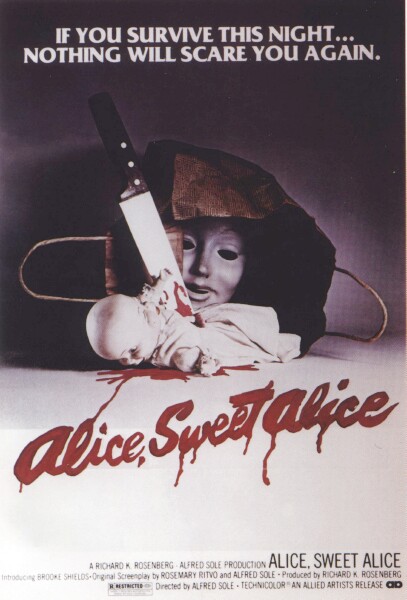
ALICE, SWEET ALICE (1976)
Proto-Slashers frequently contain more plot and depth of character than later straight up classic slashers. A case in point is Alfred Sole’s killer-on-the-loose feature “Alice, Sweet Alice” (a.k.a. “Communion”, a.k.a. “Holy Terror”). Set in 1960’s New Jersey, “Alice” creates a perfect sense of time and place as a young girl prepares for her first communion. Unfortunately (or fortunately, since this is a horror flick), she’s murdered on the big day and her slightly older sister, Alice (Paula Sheppard) becomes the main suspect. A series of murders and knife attacks follows, generating some truly great set pieces.
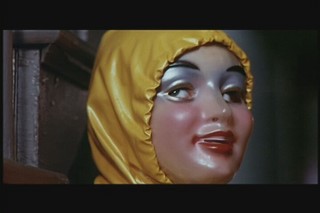
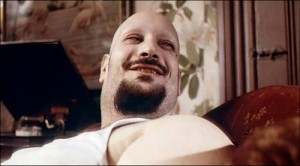
If it’s true that a thriller is only as good as its villain, then “Alice” fits somewhere close to the top of the killer class. This knife-wielder is genuinely creepy and unforgettable, dressed in a yellow raincoat (in an oft noted nod to Nicholas Roeg’s essential “Don’t Look Now”) and wearing a clear mask with painted features. Equally unforgettable is Alphonso DeNoble as Mr. Alphonso, a very large cat-obsessed potential pedophile!
“Alice” is one in a string of deeply Catholic horror movies that emerged in the 70’s (“The Exorcist”, “The Omen”, “The House of Mortal Sin”, etc.). Here, the rituals and icons of the religion are used to eerie and atmospheric effect to explore themes of guilt and sin. Key scenes are set in a church or a manse populated with priests, nuns and the devout. In fact, the atmosphere is primary to the flick’s effectiveness, as the characters deal with their guilt and suspicions about who’s doing the slashing. The cast adds to the overall oppressive atmosphere, giving strong and believable performance with the stellar Sheppard a standout. Also of note is a very young Brooke Shields, here in her much exploited acting debut.
Though “Alice” is sometimes deliberately paced, it’s punctuated by some terrific suspense scenes. It’s a very good movie, almost a great one, and necessary viewing for horror movie fans. And that mask is enough to give anyone nightmares.
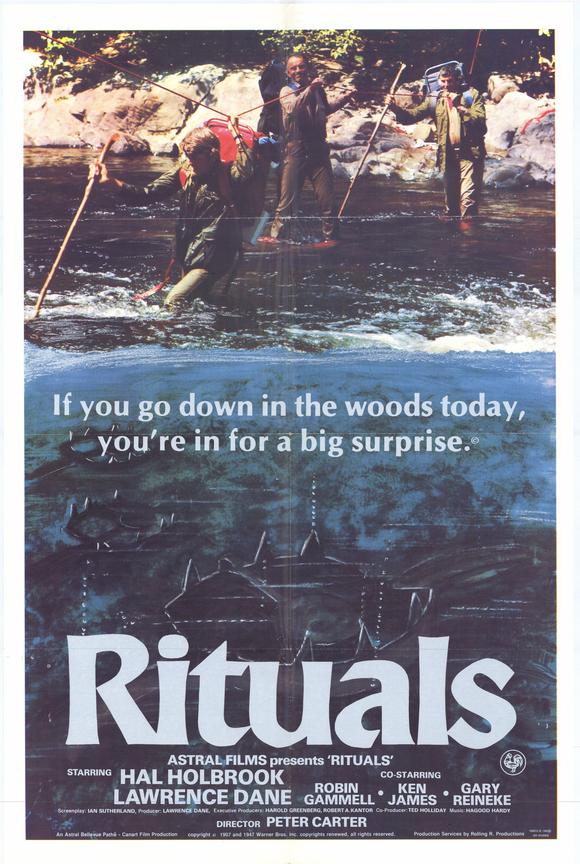
IF YOU GO DOWN IN THE WOODS TODAY, YOU’RE IN FOR A BIG SURPRISE.
First up, a confession… I shamelessly neglected to mention this terrific flick in my “Great Red North” piece about Canadian slasher flicks a few months back. Truth is, it should have been front and centre in the piece.
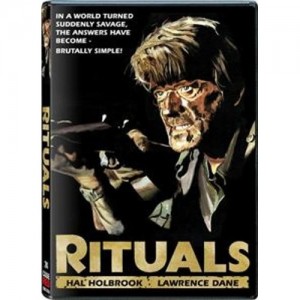
“Rituals” is an entertaining 1977 Canuck horror flick directed by Peter Carter about a group of doctors lost in the Canadian wilderness who are stalked by a killer while on a camping trip. Bearing more than a passing resemblance to the great “Deliverance”, “Rituals” generates its own vibe by focusing on the stalking and killing aspects, generating a canoe-full of suspense in the process. Hal Holbrook stars as the, er… Final Doctor(!). Of the slasher films to come in its wake, “Rituals” most reminds me of “Just Before Dawn” (or vice versa since “Dawn” came a few years after “Rituals”).
“Rituals” has had a tragic history on video/DVD. Available on an OOP Astral VHS, on countless awful quality DVDs usually under its goofy alternative title “The Creeper”, and in a perfect and uncut presentation screened from time to time on Canada’s Scream Network, Code Red DVD is finally giving “Rituals” the release it deserves. Struck from original vault elements and presented uncut, “Rituals” will either see the light of day on November 17 (as Amazon’s website pre-order service promises) or on December 22 (as Code Red’s web site says). Either way, “Rituals” is a creepy must-have for those looking for an interesting take on the slasher genre. Stephen King is a fan; with gore effects by Carl (Friday the 13th Parts 2 & 3) Fullerton, you probably will be too.


 >
>