THE MAD AND THE MACABRE pt.2 – The Texas Chainsaw Massacre 2 (1986)
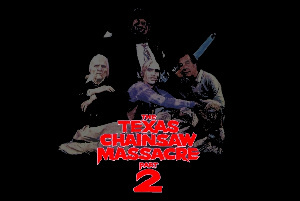
Director: Tobe Hooper
Writer: L.M. Kit Carson
Starring: Dennis Hopper, Caroline Williams, Jim Siedow, Bill Moseley
Rating: R (USA), 18 (UK), MA (Australia)
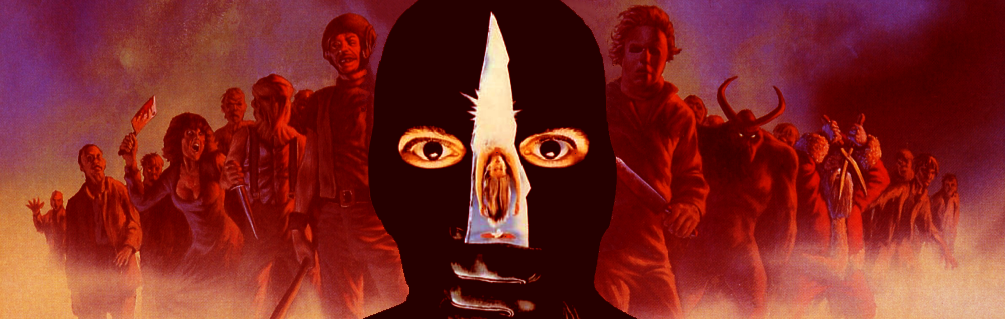
Director: Tobe Hooper
Writer: L.M. Kit Carson
Starring: Dennis Hopper, Caroline Williams, Jim Siedow, Bill Moseley
Rating: R (USA), 18 (UK), MA (Australia)
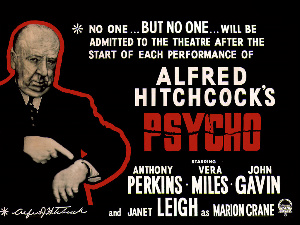
Director: Alfred Hitchcock
Writer: Joseph Stefano
Starring: Anthony Perkins, Janet Leigh, Vera Miles, John Gavin
Rating: R (USA), 15 (UK), M (Australia)
Director: Wes Craven
Writer: Wes Craven
Starring: John Saxon, Ronee Blakley, Heather Langenkamp, Amanda Wyss
Proto-Slashers: Looking at the flicks that paved the way for Halloween and the heyday of slasher movies.
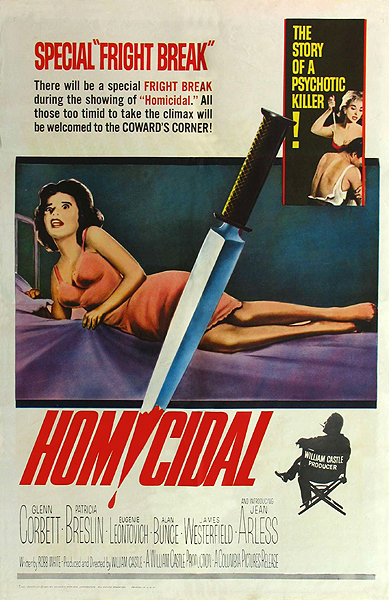
Homicidal (1961)
I love William Castle movies… The Tingler, The House on Haunted Hill, Mr. Sardonicus, Macabre, I Saw What You Did, 13 Ghosts, The Night Walker, Straight-Jacket. I mean, what’s not to love? Castle made movies that attempted to give the horror audiences of the 50’s and 60’s what they wanted – fast paced fear flicks that genuinely tried to generate some thrills. Sure he had to resort to gimmicks sometimes, but that’s part of the fun. Whether is was wiring seats to gives movie goers a mild shock, or releasing a fake skeleton on a wire overhead, Castle went all out to deliver the goods.
After Hitchcock had a major hit with Psycho in 1960, Castle responded the following year by producing and directing Homicidal. To help lure audiences, Castle created the Fright Break and Coward’s Corner. Just before the film’s twist ending was revealed, a clock appeared on the screen accompanied by a voice over informing viewers that they had 45 seconds to leave the auditorium if they were too frightened to see what was coming next. Those who left would receive a full refund, but there was a catch. Walkouts would have to sit in Coward’s Corner, a booth in the theatre’s lobby. They would have to remain there until the movie was over and everyone else who was brave enough to see how Homicidal ended had walked past, undoubtedly jeering. But nah, I can’t imagine anyone opting for that humiliation.
Homicidal tells the story of a mysterious woman (Jean Arless) who checks into a hotel and offers the bellboy a large sum of money to marry her. He agrees, and after a murder occurs, we find out that the Mysterious Ms. lives in the small California community of Solvang where she cares for her husband’s wheelchair-bound former governess (Eugenie Leontovich). Why she does this, I dunno. Enter Arless’ husband, his sister (Patricia Breslin) and her boyfriend (Glenn Corbett), and the stage is set for a murder party straight out of the Psycho handbook. Just why all these murders take place is reveled in a convoluted twist ending that most audiences will have guessed long before the film’s end.
On my first viewing of Homicidal at a film festival a few years ago, I fell victim to a laughing fit as the film’s surprise became immediately apparent upon its introduction. It was a “Is everybody seeing this?” kind of moment. As it turns out, most people in attendance were indeed seeing the same thing I was, judging by the amount of knowing laughter spreading throughout the theatre. I can’t speak for everyone else at that screening, but I can tell you that I wasn’t laughing “at” Homicidal, but I was laughing at it’s audacity. I’ve always appreciated Castle’s willingness to put any and every over the top element he could think of up there on the screen in the name of entertainment. That’s something that some of the more outrageous slasher films would eagerly adhere to twenty years later, and it’s a reflection of Castle’s genuine showmanship. Castle’s horror movies always had a keen sense of entertainment delivered through their “stop at nothing” attitude that never truly looked down at their audiences. Instead, Castle’s flicks respected their audiences’ desire to have a good time and a few scares at the movies. Recently, I watched Homicidal again with a couple of pretty savvy movie viewers, and I was stunned when they didn’t catch on to the film’s twist until the end of the movie. It was good to know, however, that the movie could still work on the unsuspecting.
Homicidal is a fun viewing experience and a tiny step forward on the road from Psycho to Halloween. Its campy aspects are part of its charm. Even guessing the film’s twist shouldn’t stop you from enjoying the out of control plot and the film’s set pieces. A couple of the murders in particular come as a surprise even today. Following Psycho’s lead, one slash-a-thon especially comes out of the blue and features more black & white blood than expected, and another, using a trick Castle would repeat in Straight-Jacket, entails a body part being removed in silhouette.
Incredibly, Homicidal managed to end up on Time Magazine’s Best Films of the Year List, an honour the magazine had denied Hitchcock’s film a year earlier. So why not do like Time, and pay an over-the-top tribute to this proto-slasher yourself? Get your hands on the DVD, have some friends over, and recreate Coward’s Corner in your living room. Isn’t it time you had a Fright Break?
Proto-Slashers: Looking at the flicks that paved the way for Halloween and the heyday of slasher movies.
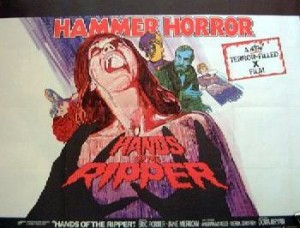
Hands of the Ripper (1971)
Suppose an infamous serial killer had a baby daughter who witnessed her father murder her mother. Years later, the memory of the event buried, the daughter commits a series of murders herself. That’s the premise of the 1971 Hammer thriller Hands of the Ripper, a terrific and not nearly famous enough late-era flick from the genre-defining British film studio.
As the title reveals, the serial killer/bad role model here is Jack the Ripper. Though his vaguely diseased and scarred face is seen only briefly in the film, appearing in the opening and in several quick flashbacks, his influence is felt throughout. In my books, madmen don’t come much creepier than the Whitechapel Murderer.
The plot really begins to get cooking when Anna (Angharad Rees), the Ripper’s daughter and now a young woman, is taken in by Dr. John Pritchard (Eric Porter). The good doc is obsessed (is there any other kind of doctor in horror flicks other than the obsessed ones?) with unraveling the secrets of the mind, especially those of the schizophrenic. Recognizing the signs of the disorder in Anna, the doctor sets out to cure her, developing a particularly unhealthy variety of codependency. As Anna begins killing, Dr. John (as Anna calls him) hides her crimes, allowing her to continue her murderous behavior.
Though we always know who the killer is, part of the grisly fun of Hands of the Ripper lies in waiting to see who will set Anna off and how. You see, each time the Junior Miss Ripper kills, she falls into a sort of catatonic trance first, facilitated by a kiss and a shiny object glistening in her eyes. It’s surprising how many ways screenwriter L.W. Davidson and storywriter Edward Spenser Shew find to bring these two elements together, happily ushering in yet another attack with yet another sharp object. When the killings do occur, they’re sudden and bloody, often catching the viewer off guard with their urgency.
Davidson and Shew have also given us interesting characters in Anna and Dr. John, as well as in some of the supporting characters. Anna, though a vicious killer, is sympathetic and likeable (when not slashing someone’s neck) and Dr. John is single-minded and purposefully blind to the danger he’s enabling, but with more than enough humanity to be a-okay otherwise. In bringing them together, Davidson and Shew have constructed a much more complex relationship than at first meets the eye.
Davidson/Shew and director Peter Sasdy make good use of the Whispering Gallery at London’s St. Paul’s Cathedral during the film’s climax. It works both as a dramatic setting and, on a more hoighty toighty note, as a metaphor laden with whispers and repeating cycles. Hitchcock would be proud of their use of local landmarks and Freudian hoo-haw. Of course, being a Hammer Horror, Hands of the Ripper is literate and thick with period atmosphere. Though this might all sound a little mellow or highbrow for some gorehounds’ tastes, my advice is to slow down and smell the… er, blood.
Hands of the Ripper is a neat twist on Slasher conventions even before Slasher movies proper existed. Unfortunately, it has yet to be available on Region 1 DVD. Resourceful Ripper freaks, however, can find VHS copies and DVD-R versions available online, and those with Region Free players can pick up the Region 2 disc. With any luck though, MGM’s Midnight Movies series might just see fit to release this flick into the hands of Ripper fans in North America too.
One of the most beautiful things about the horror genre is how utterly subjective it is. One man’s Madman is another man’s Prom Night. OK, I love both of those movies, but you get my point, see? I have spent years analyzing what it is about certain slashers that chill me to the bone. Even now, after so many films, I can still be surprised by what has an effect on me. Case in point, Ghostkeeper.
Ghostkeeper is a truly bare boned affair. Filtered with only a few characters, located mostly in one building and featuring very little in the way of gore, there’s still something so… uh… good, which even now after thinking about it for a couple of days, I just can’t explain. But I won’t let that stop me from trying!
Riva Spier is Jenny, a quiet girl who finds herself in a dead end relationship with Marty (Murray Ord) and together they embark on a vacation that feels anything but fun. They are visiting a desolate, snow-covered mountain with their party-girl buddy Chrissy (Sheri McFadden) and the three take off to parts unknown. After a minor accident, they find themselves seeking shelter at the Deer Lodge, an abandoned hotel. Well, maybe it’s abandoned, since they notice the heat running, even though the guest book informs them there haven’t been any visitors in five long years. Looks like they were right, and finally encounter a creepy old lady referred to in the credits as the Ghostkeeper (Georgie Collins, who truly has a disquieting aura about her). She attempts to boot them out, but because of the ferocity of the storm, she relents and they spend the night. That’s when things get weird. Apparently, this Ghostkeeper is keeping a surprise in her basement. And it’s hungry!
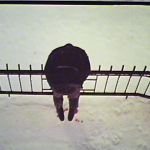
Ghostkeeper doesn’t rely on characterization or story and finds its greatest strengths in the ambiance and the score (by Paul Zaza who also did Prom Night and My Bloody Valentine, among others). There are long stretches of nothingness, yet in that space of air, there’s a feeling of dread so thick you could cut its bloodied heart out with a knife! The desolation in the snowy mountains only heightens the claustrophobia as the film heads towards an ambiguous ending.
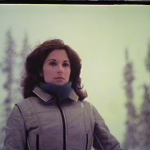
Spier is an interesting actress. She’s gorgeous and because the film doesn’t contain a lot of dialog, she expresses herself mostly with cold stares. I can’t tell if Spier wasn’t very good in the part or was fantastic, because her wooden performance actually feels right for some reason. Perhaps it’s because Jenny is terrified of inheriting her mother’s insanity and it’s that fear that keeps the character distant and slightly blank, as if taking in her surroundings before figuring out if it’s safe to react. The rest of the cast is fun, with Collins the stunning winner. Just thinking about her creeps me out.
Loosely based on the Wendigo legend, this Canadian horror film is slasher and monster lite, but has oodles of snow and deep synthesizer sounds to keep you going. Like Madman, or more appropriately, The Prey, Ghostkeeper isn’t hampered by nothingness, it’s enriched by it.
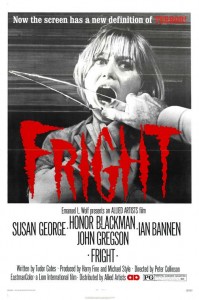
Proto-Slashers: Looking at the flicks that paved the way for Halloween and the heyday of slasher movies.
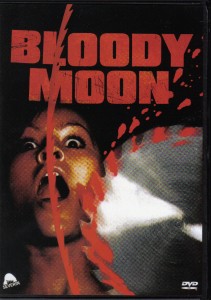
During my reckless teenage years I developed an addiction to Jess Franco flicks. My favorite Franco flick, other than those made with Klaus Kinski, is Bloody Moon. Severin recently released Bloody Moon on dvd so now I’m finally able to see Jess Franco’s only slasher uncut. And boy does the blood flow now.
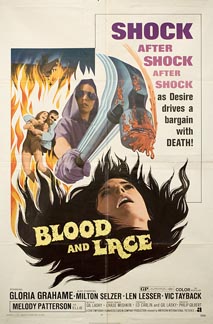
Blood and Lace (1971)
Proto-Slashers: Looking at the flicks that paved the way for Halloween and the heyday of slashers.
“Lurid”. What a great word. It promises the taboo and the gruesome. And it’s the perfect word to describe “Blood and Lace”, the 1971 picture from AIP. In fact, the sleaze factor is a key element in this sick little flick’s success.
Not to be confused with Mario Bava’s “Blood and Black Lace”, “Blood and Lace” follows almost-21-year-old Ellie Masters (Melody Patterson from TV’s “F-Troop”), as she’s placed in an orphanage after the murder of her mother, the town tramp (It’s fun to watch as more and more male cast member reveal their trysts with the deceased). Unfortunately, the childrens’ home is run by the sadistic Mrs. Deere, played by Gloria Grahame (“It’s a Wonderful Life”, “The Bad and the Beautiful”) who routinely tortures her non-compliant charges and has them killed when they attempt to run away. In order to make sure she continues to receive cash from the county for the dead kids, Mrs. Deere freezes their bodies, only taking them out of the walk-in when the inspector comes to count heads.
Adding immeasurably to the sleaze level is a couple of great character actors. Len Lesser, known to millions of sitcom fans as Uncle Leo from “Seinfeld”, is on hand as Mrs. Deere’s drunken assistant who’s also an ace with a meat cleaver, and Vic Tayback, Mel from TV’s “Alice”, is an overly involved detective who wants to make sure that no harm befalls Ellie. Add to that a hammer-wielding psycho with a burned face who is lurking around the orphanage, and you’ve got yourself a prime example of an exploitation flick from the genre’s Golden Age.
Do any research about “Blood and Lace” and four key references continually pop up. The first is the quote attributed to Michael Weldon in his invaluable “Psychotronic Encyclopedia of Film”, wherein he calls the flick “One of the sickest PG-rated films ever made…” A second point of interest is the casting of an incredibly young Dennis Christopher (“Fade to Black”, “Breaking Away”) as one of the orphans. Thirdly, you’ll find claims that the crispy-faced psycho is a forerunner of Freddy Krueger, but in my estimation, that’s pushing it. The fourth, and most directly slasher-related note is that the opening scene seems to have influenced the beginning of John Carpenter “Halloween” where Michael spies on his sister and her boyfriend, eventually killing the former. In “Blood and Lace” we enter a house from the killer’s POV, through the kitchen where we pull open a drawer and remove a murder weapon (in this case, a hammer). We enter a bedroom, and a murder is committed from the killer’s POV. From there, the two movies spin off into wildly different territory, but it’s interesting to see this connection. Carpenter’s movie is by far the better work, but inspiration has to come from somewhere, non?
“Blood and Lace” was another of those late shows I caught while I was a kid in the 70’s, it’s plot holes and iffy ethics sticking in my head like its images of hammer-smashed faces, severed limbs and frozen kids. The attractive Patterson makes an affable and engaging heroine, who’s all the more interesting for not always being the nicest kid on the (ice) block. You really get the sense that her character is at the mercy of fate, or at least Mrs. Deere and the always-leering adult male cast members. As Mrs. Deere, Graham is a terrific and creepy case study in quiet insanity.
The only feature directed by Philip S. Gilbert, “Blood and Lace” is a fun and twisted horror flick with a link to one of the pillars of the slasher genre. It’s also a movie that is criminally neglected and currently unavailable on DVD, though it’s a prime candidate for MGM’s Midnight Movie series, as they hold the rights for AIP’s output. I was lucky enough to revisit this flick via a descent grey market DVD-R from one of several companies offering this disc. “Blood and Lace” holds a few more sick surprises than what I’ve revealed here, and if you’ve ever had the urge to see what “The Brady Bunch” would look like if Carol went nuts and kept Mike’s corpse in a walk-in freezer while taking her frustrations out on the kids and Sam the butcher got handy with a hammer, this lurid little flick’s for you!
“Little fishies in a brook, Papa’s hanged you on a hook”
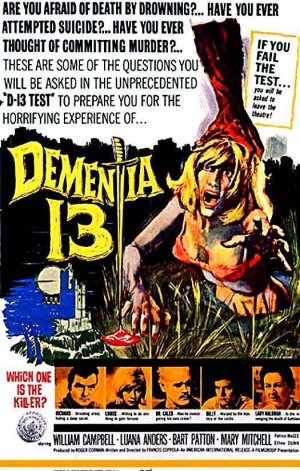
Do we agree that “Psycho” is the grandfather of slasher flicks, and that “Halloween” is the film that jump-started the craze during its heyday? If so, that means there was a solid 18 year gap between Hitchcock’s and Carpenter’s flicks, but it doesn’t mean that there weren’t lots of embryonic slashers slicing their way across North America’s drive-in screens during that time. One of these bloody beauties was Francis Ford Coppola’s first feature film as a solo director, “Dementia 13″.
The story goes that Coppola convinced producer Roger Corman to give him a few thousand dollars to shoot a film using cast members and the Irish setting from “The Young Riders”, the film they had been shooting for AIP. Though Coppola’s role on the racing pic was that of a sound technician and not director, Corman agreed as long as Coppola would create a “Psycho” knock-off that used the number 13 in its title; this isn’t so weird considering that AIP was infamous for creating its movie posters first, then making films based on the posters! Following Corman’s stipulations, Coppola quickly hammered out a screenpaly, and the shooting of “Dementia 13″ was underway. Rumour has it, though, that Jack Hill, the director of terrific genre flicks like “Spider Baby”and “Switchblade Sisters”, was called in after production to shoot additional scenes.
So what premise did the 20-something Coppola deliver?
Hiding the fact that her husabnd has recently died, Louise (Luana Anders) visits her in-laws in Ireland, intent on ensuring her place in the Haloran family inheritance. There she finds that Lady Haloran (Eithne Dunne) and her brothers-in-law, Billy (Bart Patton) and Richard (William Campbell), are haunted by the drowning death of Kathleen, the youngest of the Haloran children, years earlier. Louise starts scheming, but soon an axe murder is hacking through the Haloran family and its associates. It’s up to family doctor Justin Caleb (Patrick Magee) and Richard’s fiancée Kane (Mary Mitchel) to find out just who’s so handy with that axe.
Though the plot of “Dementia 13″ is full of holes, the movie itself is loaded with atmosphere and memorable scenes: the rowboat ride, Louise’s night swim, Lady Haloran’s visit to Kathleen’s playhouse, the groundskeeper’s fox hunt, among others. And let’s face it, slasher flicks are all about suspense and “big scenes”, those moments that either feature gory FX or unforgettable sequences. For a movie released in 1963, “Dementia 13″ is surprisingly graphic, though by 80’s slasher standards, it’s fairly mild. I first caught “D-13″ on the late show when I was about 8 years old way back in the 70’s (my first slasher flick), and it scared the hell out of me. Watching it today, the shocks still have impact, it’s a fun, eerie watch, and a definite link in the chain from Hitchcock to Carpenter. “Dementia 13″ is widely available on a number of budget-priced DVD releases, and it’s a must see for anyone interested in the evolution of the slasher flick.